The researcher, Mark de Kreij, a Greek literature expert and professor at Radboud University in the Netherlands, found the parchment while studying early Christian manuscripts that the Utrecht University library purchased in the mid-20th century, according to a Sept. 14 statement from Utrecht University. Among a collection of Egyptian and Greek texts, de Kreij found a tiny piece of parchment with words he recognized from Homer's epic.
"There are so many boring parts in the Odyssey," de Kreij told RTV Utrecht. "This happens to be a really fun passage."
The newfound "Odyssey" fragment, which is only about 2.6 by 3 inches (6.6 by 7.7 centimeters), includes verses from Book 12 of the epic. Specifically, the verses describe what happened when the sun god Helios discovered that Odysseus' men had killed and eaten his "immortal" cattle.
Odysseus had been warned by the goddess Circe to avoid Thrinacia, the island of Helios. But he and his men arrive at the island after surviving Scylla and Charybdis — a six-headed monster and a monstrous whirlpool. When Eurylochus, Odysseus' right-hand man, begs him to let them land and find food, Odysseus agrees, as long as they don't harm any cattle. But after a month of storms, with food supplies running low, Eurylochus and the men kill and eat Helios' sacred cattle. Helios asks the gods to take vengeance on the crew, and Zeus destroys their ship, killing everyone but Odysseus.
The find marks the second time this year that a fragment from a Homeric epic has been found unexpectedly. This past spring, archaeologists in Egypt discovered papyrus fragments of the "Iliad," which details the legendary Trojan War, inside a Roman-era mummy.
Both the "Iliad" and the "Odyssey" were composed in the late eighth or early seventh century B.C. and detail the 10-year Trojan War and the Greek hero Odysseus' 10-year journey from Troy back to Ithaca, respectively.
The newfound fragment likely originated as part of a parchment codex dating to the third or fourth century A.D. from the Fayum (also spelled Faiyum or Fayoum) oasis in Egypt. According to the statement, only about 30 similar fragments have ever been discovered. In an interview with Dutch News, de Kreij said the fragment may have survived because it came from the middle of the pocket-size "Odyssey" and was protected by other pages.
It's unknown how the fragment ended up in the larger collection of old Egyptian texts.
Although de Kreij first discovered the fragment in 2024, his full study of the university library's collection of Greco-Roman texts from Egypt will be published soon as a book titled "Hieratic, Demotic, Greek, and Coptic Texts in the Utrecht University Collection."
'> 1,700-year-old fragment of the 'Odyssey' discovered between pages of Dutch library book Douglas Seiler, a research affiliate of the University of California, Berkeley and a co-author of the study, said in
a statement about the new method.
Over the past few years, other researchers have digitally opened and decoded some of the scrolls from the Herculaneum villa, which was likely owned by Julius Caesar's father-in-law. These results have helped reveal the writings of ancient philosophers, largely Epicureans and Stoics, with one section even describing Plato's final burial place.
But scientists still wrestled with using X-rays to read the scrolls, since, in many cases, both the papyri and the ink written on them are carbon-based. However, some of these papyri, scientists have learned, contained leaded ink. The new study, published Wednesday (Sept. 16) in the journal PLOS One, suggests that researchers should first scan the scrolls for leaded ink and then use their new technique to read more of these long-lost texts.
This method could help improve text-detection algorithms to identify writing on ancient papyrus pages, they noted. And, in the long run, it may help to protect the scrolls.
"This provides a low-risk method to develop algorithms without endangering the priceless artifacts," the team wrote in the study.
The papyrus scrolls are prepared with inks of varying lead concentrations that an AI algorithm will detect via X-ray tomography. (Image credit: Seiler et al., 2026, PLOS One, CC0)When Mount Vesuvius erupted in A.D. 79, it buried Herculaneum under 70 feet (20 meters) of volcanic rock and ash.
Along with the 2,000 people who died at Pompeii and Herculaneum from this natural disaster, many of the scrolls housed at the Herculaneum villa were carbonized, or essentially turned into charcoal, trapping their writings in brittle rolls of papyrus that are nearly impossible to read without destroying the scroll itself.
But, given that some of the ink used in the scrolls contained lead, Seiler and his colleagues decided to do a little experiment. They created a fake papyrus scroll with lead-based ink and "carbonized" it to try matching the conditions of the scrolls found at Herculaneum.
Next, the researchers used X-ray fluorescence, which determines the elements in a material by how they interact with X-rays, to determine that these scrolls did, in fact, contain ink with varying levels of lead. Following that, they used X-ray tomography, a way to make a 3D image using X-rays, with custom-made software to re-read some of the text they had produced on their scroll.
Thanks to their technique, the researchers found that they could read the lead-based ink writings in the scrolls, even with minuscule levels of lead. While not all the writings could be deciphered, the method was able to detect differences between the text and the papyrus it was written on.
This technique, if used on other Herculaneum scrolls, could give these ancient writings a "higher probability of being successfully read," they wrote in the study.
How much do you know about the Roman town destroyed by Mount Vesuvius? Find out by taking our Pompeii quiz.
'> New trick could reveal text on 2,000-year-old scrolls charred by eruption of Mount Vesuvius
T. rex teeth from specimens found in the Hell Creek Formation in Montana.Rare, heavy isotopes of carbon and oxygen bond together differently in growing tooth enamel depending on the temperature. The number of bonds formed between these rare isotopes is greater at cooler temperatures than it is at warmer temperatures, which means warm-blooded, or endothermic animals, that can regulate their own body temperature, have fewer of these chemical bonds in their teeth than cold-blooded, or ectothermic, animals, which rely on their environment for warmth.
One of the T. rex teeth used to measure the body temperature of T. rex, which involved using a dental drill to remove some enamel and dissolved the resulting powder to release carbon dioxide gas (Image credit: UCLA)By measuring the bonds in carbon dioxide (CO2) given off when dissolving small samples from the T. rex teeth, Randon Flores, a geologist at the University of California, Los Angeles (UCLA), and his colleagues could estimate where on the scale of animal body temperatures T. rex sat.
They put the T. rex body temperature at 97.3 degrees Fahrenheit (36.3 degrees Celsius), comparable to that of a human or an elephant. Modern, cold-blooded reptiles tend to have lower body temperatures of about 82-86 F (28-30 C), while most birds — descendants from T. rex's branch of dinosaurs — tend to be much warmer at 104-109 F (40-43 C). Therefore, these findings, published Wednesday (Sept. 16) in the journal Science Advances, show how much this relative of modern birds had already diverged from cold-blooded dinosaurs like Triceratops and Stegosaurus.
"The temperature is about what I would have guessed — higher than a reptile or a slow mammal like a sloth, but lower than an avian," study co-author Robert Eagle, a geobiologist at UCLA, said in a statement.
These findings have implications for how and where the T. rex might have lived. A warm-blooded T. rex would have been an energetic, active animal, chasing or scavenging food to fuel its fast metabolism rather than basking in the sun to gain energy, wrote the authors.
It also means that during the Cretaceous period, one of the warmest periods in Earth’s history, about 11-25 F (6-14 C) warmer than today, T. rex would have been able to survive in most of the North American continent, from what is now Mexico up to chilly climates where cold-blooded reptiles wouldn’t have survived. This helps explain why a tyrannosaur fossil has been found in the Kikak-Tegoseak Quarry in Alaska, although there is no trace of other reptiles like lizards, turtles or crocodiles from that period in the region.
The ability for T. rex to inhabit cooler, high latitudes also aligns with recent evidence that tyrannosaurs crossed the Bering Land Bridge between Asia and North America, write the authors.
How much do you know about the king of the dinosaurs? Test your knowledge with our T. rex quiz!
'> Scientists finally figured out the temperature of T. rex's blood — and it was as hot as ours .
In physics, time gets even more complicated, incorporated into theories of relativity — the experience of the clock's ticking being relative to the observer and their place in space — and entropy, which gives time its unidirectional flow. Meanwhile quantum mechanics indicates time can move both forwards and backwards, at least inside quantum systems.
In this excerpt from "On Time: The Physics That Makes the Universe Tick" (Princeton University Press, 2026), author and theoretical physicist Jim Al-Khalili looks at the possibility that time did not begin with the Big Bang — but if this outburst was just another moment, what was there before?
There is an alternative cosmological theory to the one that says the Big Bang marked the beginning of time itself, which was then followed by a brief period of rapid inflation of space. The alternative is known as eternal inflation. In this scenario, our universe was born as a small bubble in an infinite space that has been undergoing inflation forever.
So, rather than time beginning with our Big Bang, we should regard the Big Bang as an event that took place at some moment in time, in which our region of this infinite space suddenly stopped inflating and began instead to expand at a more sedate pace.
So instead of a brief period of inflation happening just after the Big Bang, in the eternal inflation theory it is the other way around, with the Big Bang marking the end of inflation in our part of space, creating our bubble universe outside of which inflation continues. The theory predicts there will be other big bangs happening elsewhere that give rise to other universes — possibly an infinite number of them — all forever separated from each other, and all being driven apart by the ever-expanding, rapidly inflating space outside of them. The totality of this infinite space is referred to as the multiverse, to distinguish it from the individual bubble universes.
Some physicists argue that such an idea falls outside of proper science, since we do not have a way of testing it. There are two other ideas worth mentioning on the matter of whether the Big Bang marked the beginning of time or not, both of which are alternatives to inflation theory. The first is that our universe is part of a repeating process called conformal cyclic cosmology'.
This idea, proposed by Roger Penrose, suggests that our universe is going through an infinite series of lives, or epochs, each of which starts with a big bang and ends with a universe in thermal equilibrium, filled only with evenly spread-out thermal radiation. The idea here is not, as you might expect, that the universe reaches some maximum expansion before collapsing down to a 'Big Crunch' that then marks the Big Bang of the next epoch, but rather because of a subtle geometrical idea called 'conformal mapping' that connects up the very different end of one universe (cold and spread-out) with the birth of the next (hot and dense).
Other suggestions for a pre-Big Bang time include a mirror universe, and one that cycles endlessly through expansion and contraction. (Image credit: Curly_photo/Getty Images)I will not say any more about this theory, in particular since it has been argued that it suffers from several flaws, such as the problem of conservation of information (similar to the so-called black hole information paradox) and the difficulty of reconciling the high entropy at the end of the old epoch with the low entropy of the new epoch.
A related hypothesis, which I admit I find aesthetically rather appealing, is known as the ekpyrotic universe model. The name is based on the Greek word ekpyrosis (ἐκπύρωσι), meaning 'conflagration', which refers to a cosmological model proposed by the Stoic philosophers of ancient Greece in which the universe cycles endlessly through fiery birth, expansion, and cooling, followed by contraction, reheating, and rebirth.
The name 'ekpyrotic universe' was devised by one of the modern theory's originators, Paul Steinhardt. The idea comes out of the highly mathematical world of string theory. Basically, the whole of our three-dimensional space (which as we know is really a part of 4D spacetime) forms what is called a 3D brane (a higher-dimensional generalisation of a 2D membrane, or sheet). This 3D brane of ours is floating in a higher-dimensional (4D) space, and the Big Bang is when it collided with a neighbouring brane (in a sense this would be another universe). This collision creates tremendous heat and radiation (the Big Bang) and sets off the expansion of our space.
At the same time, it is drifting away from the other brane that it collided with, but will eventually reach maximum separation from it before they are pulled back together, colliding again in a new Big Bang. Here I simply wish to stress that if this theory is right then there may not have been a beginning of time, and certainly not at the Big Bang.
What if there were a mirror universe on the other temporal side of the Big Bang, evolving in a direction we would consider to be towards the past?
Another cosmological model, which also does away with the need for inflation, as well as suggesting that the Big Bang was not the beginning of time, has been proposed by another of the originators of the ekpyrotic universe idea, Neil Turok. But this idea, known as the 'mirror universe' theory, is rather different. It's a nice idea, and it certainly solves Loschmidt's paradox regarding the conflict between time symmetry and the second law of thermodynamics. Due to the time-symmetric underlying fundamental equations of physics, starting a system off at any arbitrary moment means that its entropy should increase equally into the past as it does into the future.
Exclusive to Live Science Pro
But this just doesn't make sense. If the system at all times before our chosen arbitrary moment has higher entropy, then starting from any of those earlier times should see the system decrease in entropy in order to reach its state at the original arbitrary moment. Therefore, it cannot be arbitrary; the system had to have been in a specially prepared state at that moment, the moment of the Big Bang. There would be no increase in entropy going backwards in time if that is when time started.
But what if there were a mirror universe on the other temporal side of the Big Bang, evolving in a direction we would consider to be towards the past? This is precisely what Turok is suggesting. What is neat (or convenient, depending on how much you like this theory) is that both sides of the Big Bang are completely separated from each other, with each seeing time pointing in the direction of increasing entropy. If such a mirror universe exists and contains intelligent life that has also hit upon the mirror universe idea, then they would think that our side was the one before the Big Bang in the same way we think that theirs is. As well as doing away with inflation, this idea also conveniently explains why there is more matter than antimatter in our universe because, guess what, the mirror universe would have it the other way round: What they call normal matter is our antimatter.
How seriously should we take these cosmological theories? Are they even proper science? Their proponents know they require some sort of empirical evidence to support their hypotheses, such as some imprint of a reality before the Big Bang frozen in our cosmic microwave background. For without observational evidence, these ideas will remain just theoretical curiosities.
Excerpted from On Time: The Physics That Makes the Universe Tick © 2026 by Jim Al-Khalili. Reprinted by permission of Princeton University Press.
Help us improve Live Science Pro: We're always trying to make our content better. Leave us feedback about Pro here.
Princeton University Press
On Time: the Physics That Makes the Universe Tick
In this mind-altering book, Jim Al-Khalili tackles the enduring problems of time head-on, carefully examining them across the three central pillars of physics—quantum mechanics, general relativity, and thermodynamics.
Al-Khalili makes the persuasive case that time is real, not illusory, and that a master arrow of time is not merely a trick of our senses but is rather a fundamental feature of reality that was baked into the structure of our universe from the very beginning.
'> Was there a 'before' the Big Bang? Jim Al-Khalili on the mind-bogglingness of time
.
Organoids offer a window into early brain development that's impossible to observe closely in humans, namely because it unfolds inside developing fetuses. Although organoids are not perfect re-creations of full-size human brains, scientists think organoids are useful models for studying the developing brain in both health and disease.
The model in the new study "certainly creates some pretty interesting options in terms of modeling human neurodevelopment and various types of neurodevelopmental disorders," Chen said. "If you're looking for a model that really allows you to look at larger areas of human neural tissue from a cellular, molecular perspective, I think there's a lot that this model has to offer."
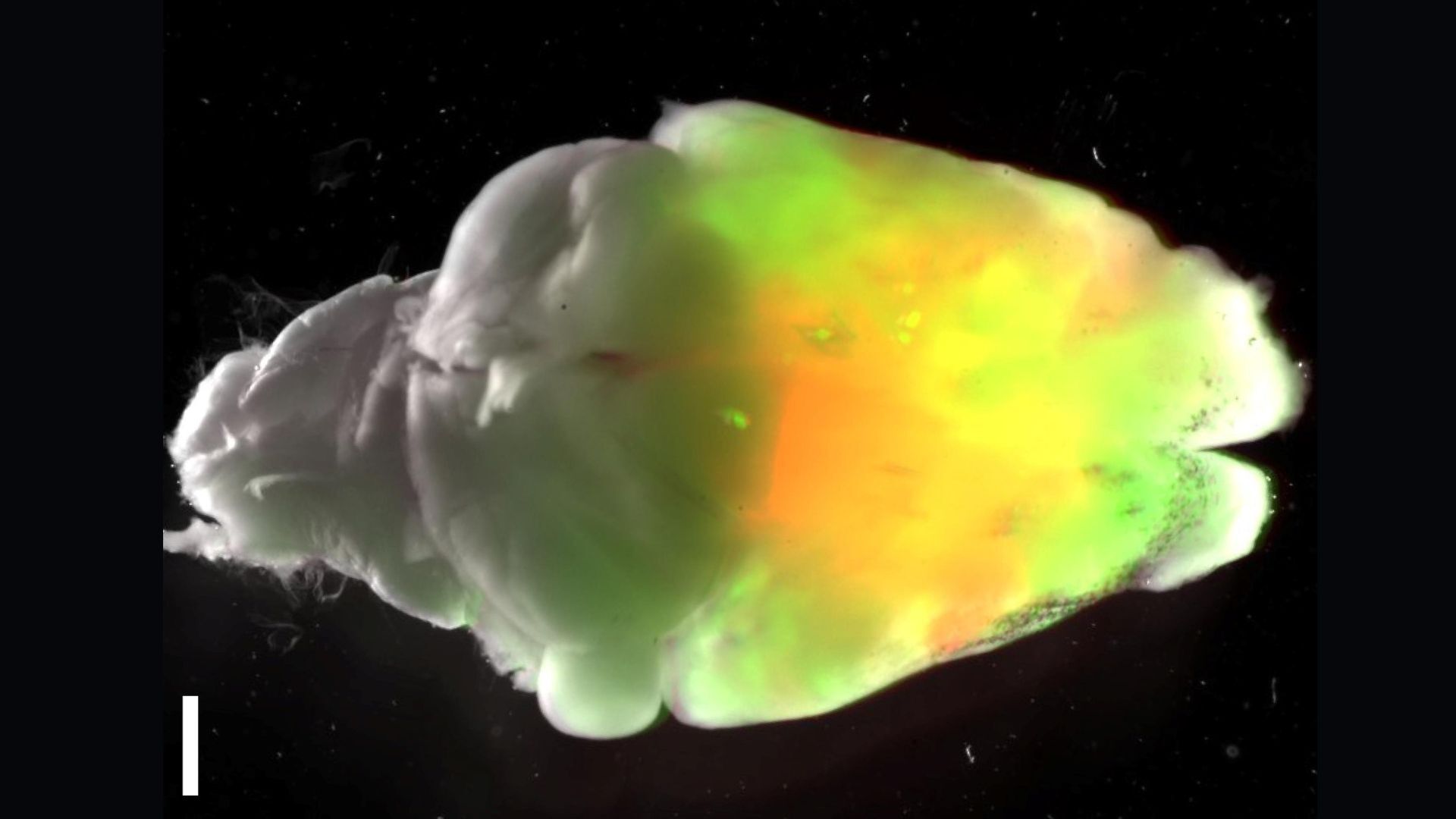 S. Pasca lab, Stanford University
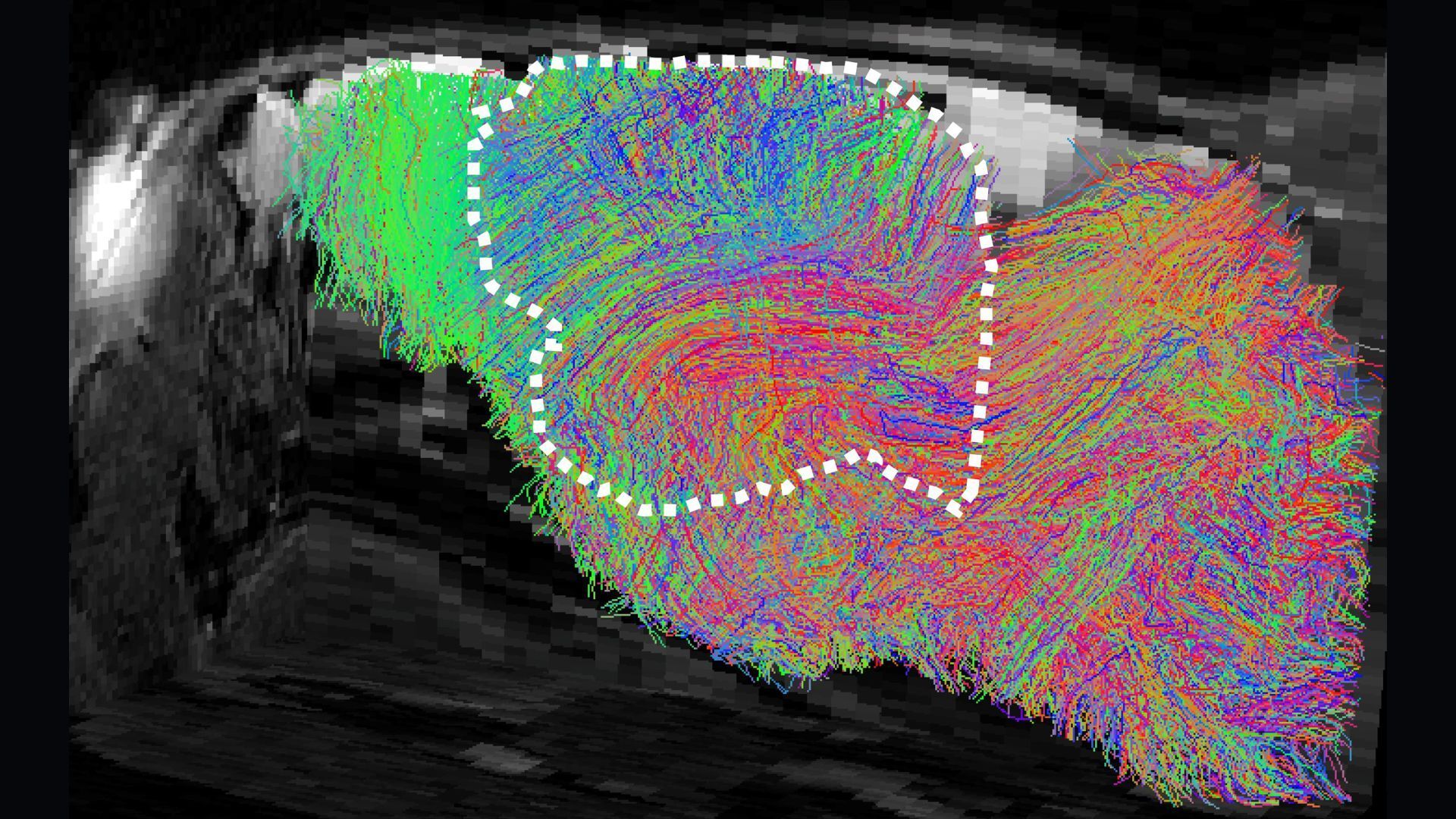 S. Pasca lab, Stanford University
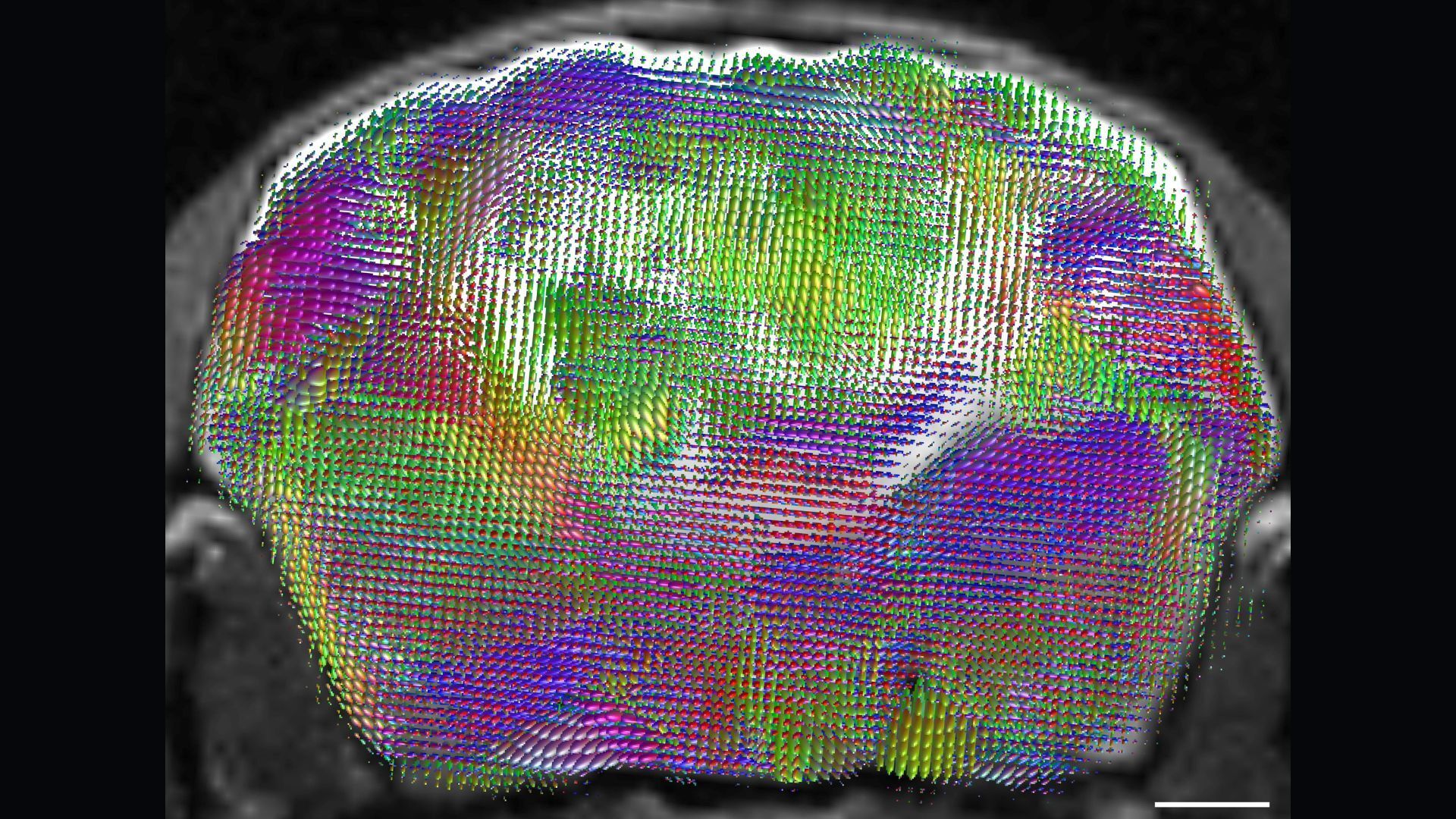 S. Pasca lab, Stanford University
Making space for human cells
Often, brain organoids are grown outside living organisms, either in lab dishes or devices that keep these "minibrains" suspended in a solution. Multiple organoids representing different parts of the brain, or even different people's brains, can also be brought together to form more-complex structures.
Why, then, are some scientists growing human organoids inside mice? One reason is that there's a secret sauce inside living organisms that helps organoids mature better in animals than they do in lab dishes. In the body (in vivo), there are mysterious signals that help direct neurons' development and organization, and these signals are missing in lab dishes (in vitro).
"There are some cues that are present in vivo that are really important, and we simply don't know what to add in, in vitro," said study co-author Dr. Sergiu Pașca, a professor of psychiatry and behavioral sciences at Stanford University. The team demonstrated this phenomenon by transplanting organoids into lab rats in a study published in 2022; the transplanted organoids grew larger, formed better connections and were more active than organoids grown in dishes.
But transplanting human brain cells into rodents comes with different challenges. One is that human brains mature at a slower rate than rodent brains do. "Even when they're put in an animal, in a mouse or in a rat, they will still develop about 20 times slower than the mouse or the rat," Pașca told Live Science.
The host's brain cells quickly grow and form new connections, while the human cells lag behind and get outcompeted, Pașca explained. This limits the amount of space that the human cells can take up. As neurons mature, they become myelinated, meaning they gain fatty insulation that helps them communicate more efficiently. The rodent neurons become myelinated more quickly than the human cells do, and that fat creates a physical barrier that the human cells struggle to penetrate, Pașca said.
In their study, described Wednesday (Sept. 16) in the journal Nature, Pașca and colleagues aimed to give the human neurons a leg up. They couldn't solve the issue of human cells maturing slowly, but they could lend the cells extra space to grow in.
Through years of work, they developed a genetically modified mouse that develops only 2% of its cerebral cortex. The majority of its hippocampus — a major memory center in the brain — is also missing. Within a few days of the mouse's birth, the team transplants human neural tissue into that vacant space, and about 90% of the time, that human tissue integrates successfully and starts to grow, Pașca said.
The brains of normal lab mice look like the brain on the left, whereas the center brain is missing 98% of its cortex and hippocampus. The brain on the right has human cortical tissue added to it. (Here, "XCX" is short for "xenocortical," and "xeno" references the transfer of tissues from one species to another.) (Image credit: Pasca Lab/Stanford University)"We just took cortical organoids, about four of them, and transferred them with a syringe into that vacant space," he said. "That's it. They go in there, they graft, and within a few weeks, they start to grow. And then within a few months, they've taken most of that volume."
In the weeks following the transplantation procedure, the human brain cells in the mice's heads grew, formed connections and extended projections into the underlying mouse tissue. The human tissue didn't organize itself into distinct layers as it normally would inside a human's head, but it included many cell types that are typically seen in the human cerebral cortex.
Future of the field
The researchers compared the mice imbued with brain organoids with mice that were missing the same amount of brain tissue but didn't get organoids. They also compared both groups to unmodified lab mice.
Perhaps surprisingly, the mice missing large chunks of their brains still functioned fairly well. "You look at them, and you can't really honestly tell," Pașca said. Upon closer inspection, though, the mice had subtle deficits in their fine-motor skills, working memory and socialization, he noted.
"From our perspective as humans, so much of what we do day to day depends on the cortex," Chen noted. But in a mouse, the cortex makes up a minority of the overall brain, and various studies have suggested that the animals can get by without it, he said. "I don't think the transplantation process itself is significantly hurting the animal," he added.
It would be much more problematic if this was to happen in a species that has a larger brain and is closer to humans evolutionarily.
Dr. Sergiu Pașca, a professor of psychiatry and behavioral sciences at Stanford University
In the future, the ability to compare these three sets of mice — with organoids, without organoids, and unmodified — could help scientists tease apart how the human tissue is contributing to a given experimental result. Pașca envisions that the approach will be useful for studying the effects of insults to the brain, such as hypoxia (low oxygen) and exposure to toxins or drugs in the womb. Additionally, the genetics of the human organoids could be tweaked to see how those changes affect the brain's development, structure and function. That could be useful for studying cerebral palsy or autism, he suggested.
Chen expects that this new approach will be useful for studying aspects of early brain development at the molecular and cellular levels. The new model incorporates a larger volume of human tissue than models have done in the past, and that's an additional advantage. The human tissue doesn't organize itself into layers or lobes as you'd see in a real human brain, he noted, but he thinks there's still a lot that can be learned from it.
From an ethical standpoint, Pașca consulted with experts at Stanford and an external ethics committee regarding the welfare of the animals used in the study. Studies that involve putting human brain tissue into animals also raise questions about whether that added tissue could grant the animals new cognitive abilities — make them more human-like, in essence. The ethics committee fielded these concerns as well.
"We have not seen emergence of any new properties," Pașca noted. "It's not surprising because we're still at a very early stage of development." They grew the organoids for only six months, so the human organoids were roughly as developed as a 6-month-old fetus's brain tissue.
If the organoids matured to be more human-like — developing layers and lobes — that might present more of a concern. But both Pașca and Chen said that type of development might be hard to recreate in a mouse anyway.
Chen argued that the sheer size of the human brain contributes to its complexity, and it also contains specialized regions that work together to execute different tasks. A mouse's head cannot support the scale of a human brain, and at this point, organoids don't develop the same organization and specialization that we see in people, he said.
"It would be much more problematic if this was to happen in a species that has a larger brain and is closer to humans evolutionarily," Pașca argued. Pigs and nonhuman primates, such as monkeys, would be examples. Especially in regard to transplanting human organoids into monkeys, "that would be an experiment that I don't see is justified at this point," Pașca said.
See how much you know about the most complex organ in the human body with our brain quiz!
'> Scientists shrank mice's brains and replaced the missing tissue with human 'organoids'