The child was buried alongside two ceramic objects depicting defeated warriors about to be sacrificed. (Image credit: Huacas de Moche Archaeological Project - UNT)Archaeologists in Peru have found an elaborate 1,500-year-old tomb that may hold the remains of a high-status toddler from a pre-Inca civilization.
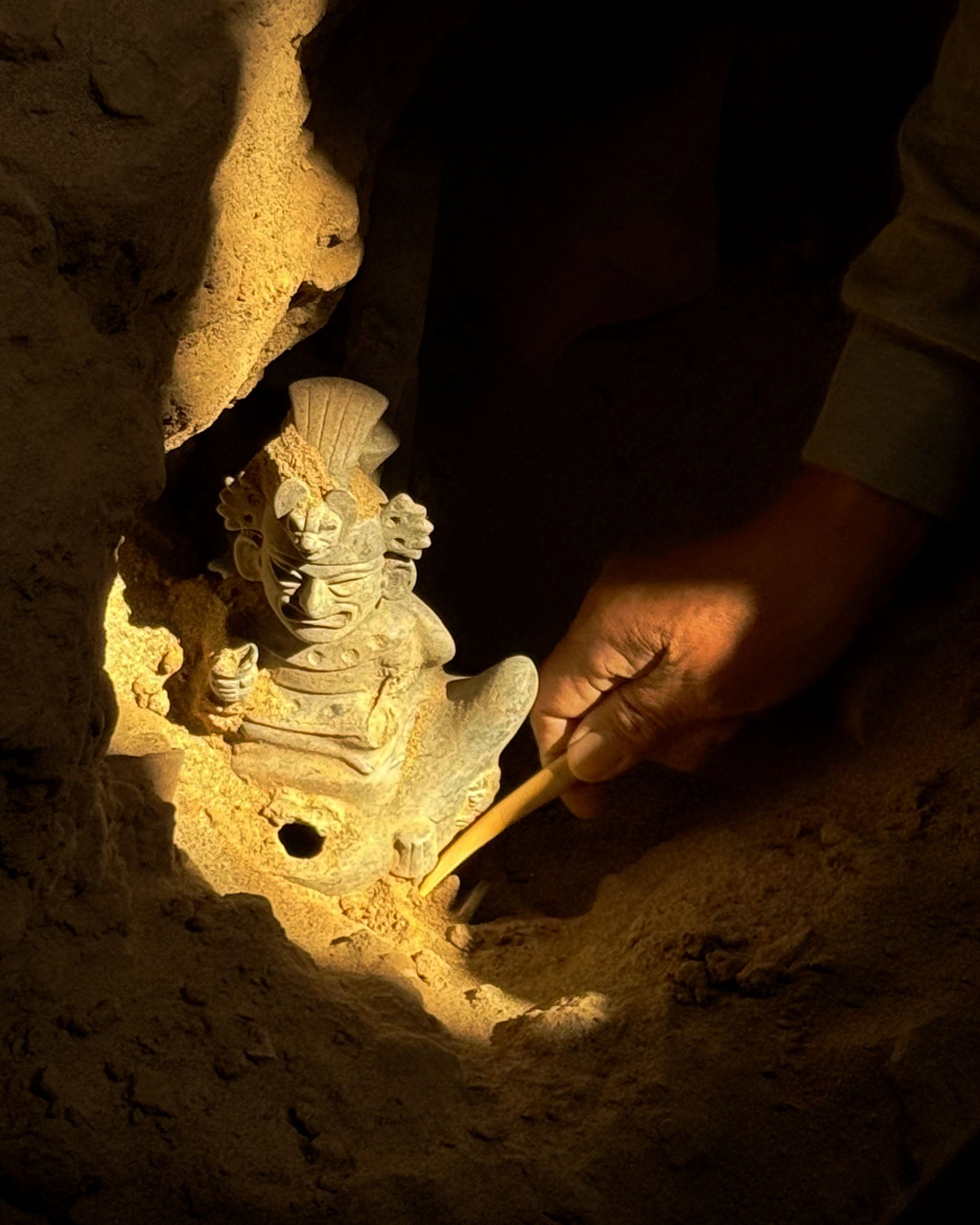
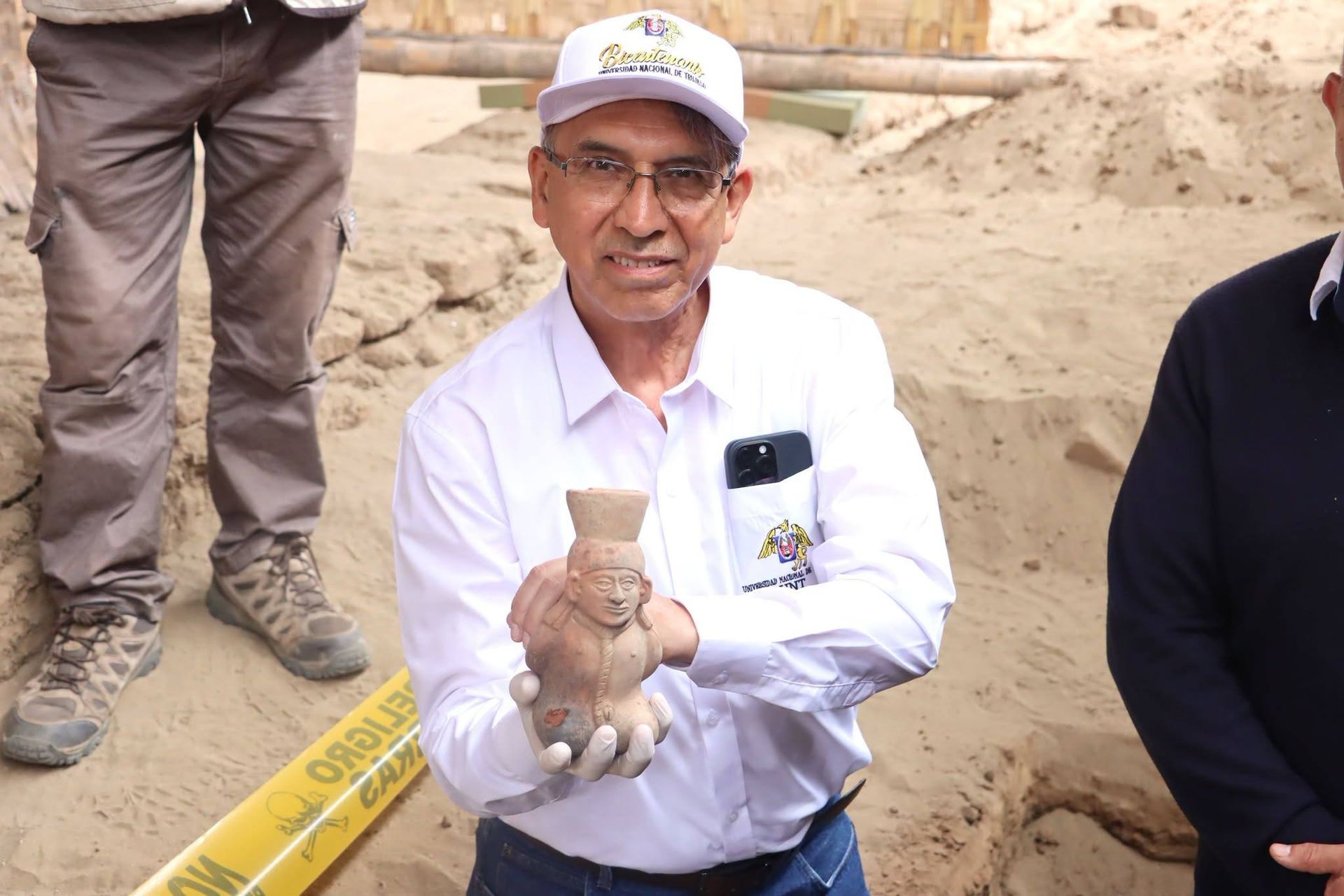
The burial, which is from the Moche culture, also contained vessels depicting prisoners with rope around each of their necks and a sculpture of a human-bird deity.
Moche (also known as Mochica) culture developed along the northern coast of what is now Peru from the third to the ninth century. They created agricultural lands in the region's desert landscape, and their archaeological record includes monumental temples, water canals, pottery, metallurgy, textiles and a distinctive form of art. The Moche didn't have a written language, but they left behind thousands of realistic portrait vessels, which are somewhat similar to the prisoner sculptors found in the toddler's burial.
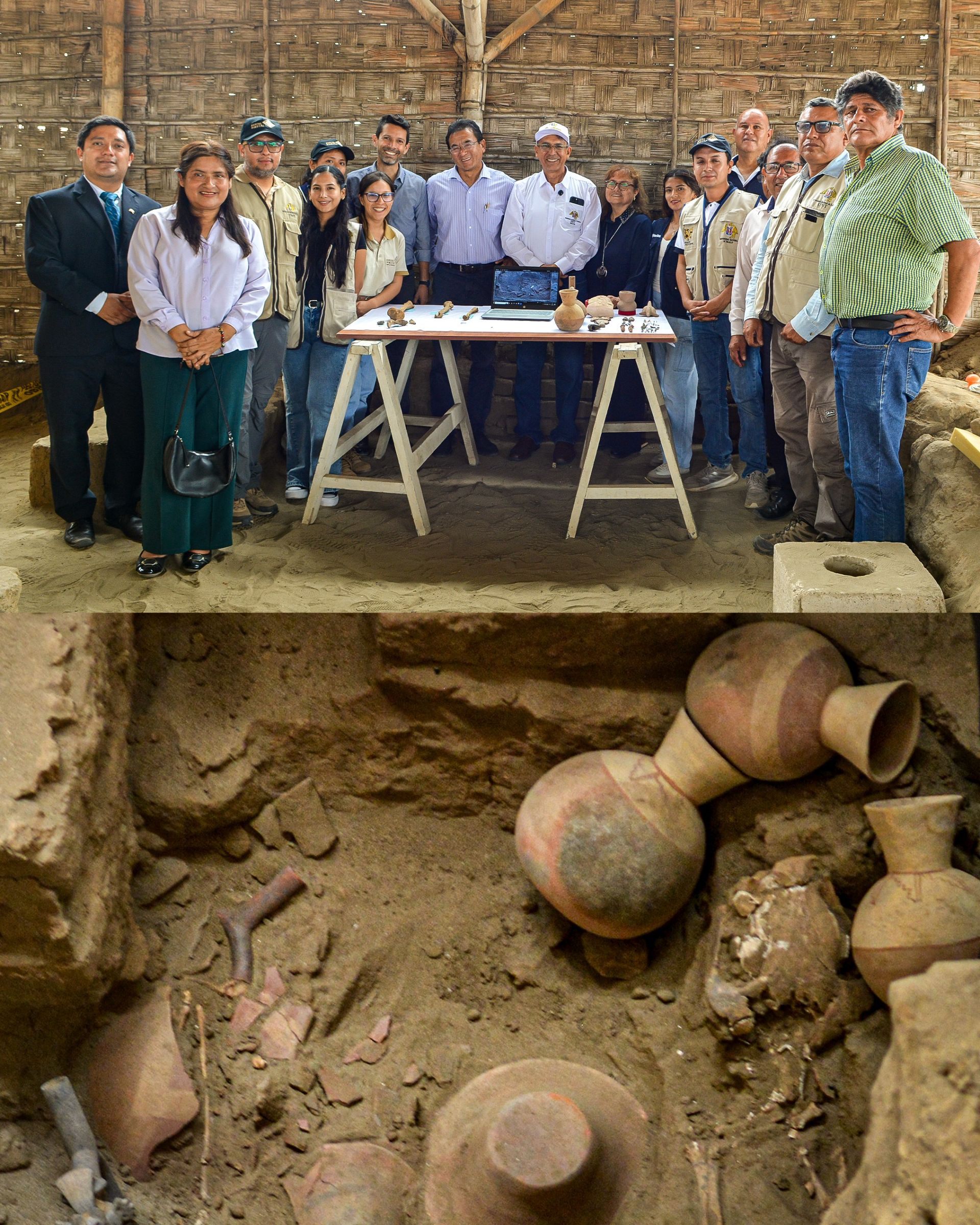
In the newfound tomb, the team unearthed a small skeleton, which is likely the remains of a toddler who was, at most, 2 years old, Carlos Rengifo-Chunga, director of the University of Trujillo's Huacas de Moche Archaeological Project, told Live Science. The child's sex is unknown.
The child was buried alongside 32 ceramic objects associated with Moche culture. (Image credit: Huacas de Moche Archaeological Project - UNT)Rengifo-Chunga and his colleagues also found two copper objects in the burial: a mask-like disk covering the child's face, and a half-moon object on their feet. In addition, the burial contained 32 ceramic objects associated with Moche culture, including those depicting the prisoners and the deity.
The tomb was large compared to the child's small size, and could have easily held an adult, Rengifo-Chunga said. It dates to the sixth or seventh century, he added.
The team unearthed the tomb inside the Uhle Platform at the Huacas de Moche archaeological site in northern Peru. The Uhle Platform is a mausoleum, attached to the Huaca de la Luna temple, with a patio archaeologists call the Patio of the Serpents. Of the more than 80 burials previously uncovered there, the tomb represents the only known child to receive this sort of lavish burial.
The elaborate funerary treatment, including the use of copper, and the location of the tomb all suggest that the child belonged to an elite class of Moche society, Rengifo-Chunga said.
The two prisoner sculptures are associated with the "ritual of combat," a common theme in Moche art. In this sort of imagery, two warriors fight each other, and the loser is stripped of his clothes and weapons, tied around the neck with a rope and offered as a human sacrifice, Rengifo-Chunga said. The prisoners depicted on these two vessels were the losing warriors, and their presence in the burial of a child is rare.
"One would normally presume that these kinds of vessels represent something related to the deceased's life," Rengifo-Chunga said. For example, a vessel like this might signify that the individual took part in combat.
 Huacas de Moche Archaeological Project - UNT
 Huacas de Moche Archaeological Project - UNT
 Huacas de Moche Archaeological Project - UNT
But a toddler couldn't have taken part in such an activity. In general, archaeologists wouldn't expect to see elements of an adult ritual in the burial of a child. "This expands our knowledge on Moche funerary practices," he added.
The sculpture of the presumed deity depicts a human body with bird wings and a bird tail, although for some scholars it might be interpreted as a god in transformation, Rengifo-Chunga said. The deity holds a square shield in one hand and a goblet in the other, and is flanked by two bird "assistants" wearing ceremonial garments.
Researchers will have to investigate whether the deity is a known Moche god, or a newfound addition to the pantheon. Either way, the object joins a contentious debate over whether the Moche pantheon consists of many gods, or just a few that can transform into many different versions, Rengifo-Chunga said.
The artifacts are now in the laboratories of the Santiago Uceda Castillo Museum in Peru, where they will undergo conservation treatment.
How much do you know about the first people to reach the Americas? Find out with our First Americans quiz.
'> Rare burial of elite toddler from pre-Inca culture discovered in Peru
The gold accessory was found in a Bronze Age grave near the town of Mold in Wales. (Image credit: Alamy)QUICK FACTS
Name: Mold gold cape
What it is: A hammered gold accessory
Where it is from: Bryn yr Ellyllon (Goblins' Hill), Wales
When it was made: Circa 1900 to 1600 B.C.
In 1833, stone quarry workers discovered an ancient burial mound at Goblins' Hill near the town of Mold in Wales. At the center was a stone-lined grave that contained a fragmented skeleton and a gold, cape-like accessory that had been crushed over time. The Mold gold cape has a unique shape and style, and it is one of the finest examples of prehistoric goldwork ever found, according to the British Museum, where the artifact is on display.
The cape dates to Britain's Early Bronze Age (2500 to 1200 B.C.), a time that saw a metalworking revolution as artisans shifted from crafting flint tools to making weapons and jewelry out of gold, copper and bronze.
When the cape was originally unearthed, experts assumed that it had belonged to an ancient warrior, chief or religious leader, due to the spectacular design of the object, Benjamin Roberts, then curator for the European Bronze Age collections at the British Museum, told the BBC in 2010. But after the broken pieces of the cape were put back together, the small size of the artifact suggested it may have been worn by a woman or a child.
The Mold gold cape measures roughly 9.3 inches (23.5 centimeters) tall and 18.3 inches (46.5 cm) wide. It weighs about 1.2 pounds (560 grams) and was probably crafted from a single lump of gold about the size of a ping-pong ball.
The gold ingot was beaten incredibly thin, fashioned into a cape, and then embellished with decorations that mimicked beads or necklaces, according to the British Museum. Additionally, several hundred amber beads were found on the cape in the grave, which likely added to the gilded appearance of the accessory. Perforations around the neck opening suggest the cape originally had a lining made of leather or another perishable material that did not survive.
Because the gold cape, when worn, would restrict a person's upper arm movements, it may have been a ceremonial accessory that conferred religious authority and was worn only on special occasions. But experts are still unsure why the cape was buried in a grave. Nor can they confirm whether the person it was interred with was male or female, as the skeleton was not recovered by the quarry workers in the 19th century.
"The cape is unique — there is really nothing to compare it to in the whole of Europe," Roberts told the BBC. "This makes it more difficult to understand why it was made and what significance it had."
For more stunning archaeological discoveries, check out our Astonishing Artifacts archives.
Inuit Figurine
Maya Death Urn
Battersea Shield
Can you put together last week's Astonishing Artifact?
'> Mold gold cape: A 3,900-year-old accessory that's one of the finest examples of prehistoric goldwork ever found
Grace Liu, a doctoral student in machine learning at Carnegie Mellon University, told Live Science in an email. "If AI routinely removes that struggle, people may get the right answer in the moment but develop less robust independent capability."
Liu and her colleagues recruited 1,222 participants for the study, which was released as a preprint earlier this year and has now undergone peer review. The researchers designed three randomized controlled experiments, including two sets of mathematical fraction problems and a series of reading comprehension questions. The participants were split into three groups, so there was no overlap between the experiments. Each experiment took 13 to 15 minutes to complete.
In the first experiment, the team randomly assigned 354 participants to two groups: one that had access to an AI chatbot and one that didn't. The researchers gave both groups the same 12 fraction problems, which the AI group could get the answer to immediately or obtain clues about by prompting the chatbot. Then, the researchers removed the AI assistant without warning for a final set of three fractions, which all of the participants were given, regardless of their group.
Both groups had the option to skip problems. The researchers explicitly told the participants that there was no penalty for wrong answers, so skipping a problem was a deliberate decision to not engage with it, they wrote in the study. The participants in both groups were also given the correct answer to each problem if they got it wrong, so they could learn from their mistakes.
This first experiment showed that the participants in the AI group were more likely to solve fractions and less likely to give up when they had access to the chatbot compared with the other group. But when the AI was removed, their performance dropped and they skipped or failed more problems, suggesting that using AI impaired unassisted task performance, persistence and motivation.
The second experiment was a copy of the first experiment, but it had 667 participants and small tweaks in the trial design, including the addition of a pretest phase that helped the researchers eliminate participants who were unable to solve the most basic problems. The findings were similar to those of the first experiment, hinting that the use of AI for simple tasks harms perseverance and drive to complete those same tasks without AI, especially when AI is used to get direct solutions.
Liu acknowledged that calculators also allow people to offload computations, which could cause similar declines in independent performance. But "the reason we study AI specifically is that it allows people to offload reasoning across tasks across many domains," she said.
Calculators allow people to offload math problems, but their effects on reasoning aren't as far-reaching as the effects of AI. (Image credit: Kiyoshi Ota/Bloomberg via Getty Images)In a third experiment, the team explored the impacts of AI assistance on reading comprehension, which draws on meaning-making skills and mental-model construction — the cognitive process of building internal representations of external reality. The trial included 201 participants, who were divided into a group with access to AI and a control group. The researchers gave both groups five comprehension questions before disabling the AI chatbot and handing each participant another three questions.
The results mirrored those of the first two experiments, suggesting that reduced persistence, in particular, was not an artifact of the math problems but a general outcome of cognitive offloading onto AI.
"The most significant finding is that people who offload more have higher declines in persistence (increased skip rate), which is an important skill that cuts across domains," Liu said.
One possible reason people stop trying once they have experienced help from AI is that they get used to the immediacy of answers and perceive any method that takes longer as inefficient, the researchers wrote in the study. But studies show that persistence through difficulty is essential for skill acquisition and learning, raising concerns about the long-term impacts of using AI for simple tasks.
Scientists don't yet have a full picture of how small instances of cognitive offloading affect lasting competence and independent ability. To find out, researchers would need to track the same people for a long time and regularly measure their learning outcomes across a wide range of tasks, Liu said. But research so far suggests that an overreliance on AI erodes our cognitive fitness and mastery of subjects, according to the study.
To encourage long-term learning, capability and autonomy in people, AI models and chatbots should be designed to give directions and instructions toward a solution, rather than the solution itself — more like a tutor, the researchers argued.
"We need to work toward a future in which human abilities are, as much as possible, augmented rather than supplanted," study co-author Brian Christian, a computer scientist and researcher in the Center for Human-Compatible AI at the University of California, Berkeley, said in a statement.
'> 10 minutes is all it takes for AI assistance to erode your motivation, study shows
an iron padlock around his foot.
In this excerpt from "Killing the Dead: Vampire Epidemics from Mesopotamia to the New World" (Princeton University Press, 2025), author and historian John Blair reveals the impact the printed press had on the spread of vampiric lore — and the grizzly purported practice of ingesting the blood and organs of a vampire to prevent other people becoming one.
With the invention of printing, the circulation of European stories about restless corpses moved up several gears. Occasional early references were followed by a clutch of theological and philosophical discussions during c. 1580-1610, and then — from the 1670s — a steadily growing volume of printed academic and historical debate and commentary, reaching a climax in 1732.
Another landmark came in 1746 when the Benedictine scholar Dom Augustin Calmet published his survey of supernatural beings, which was quickly reissued in several editions, including an English one of 1759. This book's section on vampires was the most influential academic work on the subject ever published. Its straightforwardly evidence-based approach was a breath of fresh air after a long series of increasingly derivative works.
It achieved its remarkable popularity because it entered the market at the right point: saturated with so much fragmented and repetitive discussion of "vampires" (still a relatively new word), the reading public wanted a textbook. Calmet inspired a huge progeny of followers and popularisers, bringing the stories to a much wider readership; a good example of the genre is the Histoire des vampires et des spectres malfaisants [History of Vampires and Malevolent Specters] of 1820, a pocketbook that re-packages Calmet for the mass market.
Calmet's book remains the ultimate source of much modern vampire literature in Europe and America, both fictional and supposedly historical, and was transformative in bringing the topic to a wider reading public. There and elsewhere, stories were now frozen on the printed page, where later generations could read them. But they were stories still: not necessarily more reliable, and by no means stable in transmission.
The tangled story of consuming blood from vampire corpses starts in a different and very unexpected place.
The complexity of interactions between learned discourse and popular practice is illustrated by one particularly bizarre and repellant (not to say dangerous) strand in the belief-system. This is the practice of ingesting blood or organs from a supposed vampire corpse, or ashes derived from burning them, as a remedy for vampire-induced illness.
Although not wholly dissimilar from the idea that victims will recover as they watch the smoke rise from burning vampire organs — already known in 11th-century England — its shocking physicality sets it apart. Did people in pre-modern Europe really do this?
A complicating factor is the medicinal use of human blood and bodyparts, in accordance with the theories of the physician, philosopher, and alchemist "Paracelsus" (Theophrastus von Hohenheim, c. 1493–1541). A brilliant experimenter, Paracelsus believed that substances healed through occult 'influences' or 'spirits,' the most powerful being those derived from what they were meant to cure: the human body.
The fact that medicine now rejects these hypotheses should not make us view them patronizingly: in the early modern period, ingesting or anointing with substances from Egyptian mummies or the blood of executed criminals seemed as rational as doing the same with any other substance. These Paracelsian ideas entered popular practice: at a beheading in Vienna in 1668/9, a man ran forward and caught the spouting blood to cure his epilepsy.
An illustration of an execution of a vampire. (Image credit: Ferdinand; Wikipedia; CC BY-SA 3.0)The tangled story of consuming blood from vampire corpses starts in a different and very unexpected place. In 1687, a major ethnographical account of parts of West Africa by the Capuchin missionary Giovanni Antonio Cavazzi was published in Bologna. In it, Cavazzi describes magical and medical practices among the Mbundu of Angola, including a method of obtaining vital curative fluid from undecayed corpses:
When they are in a fresh and intact state when unearthed, their heads are cut from their bodies, from which it is said that blood flows out (which may happen through some illusion or deceit). It is collected and made into poultices for the sick, or mixed into their food, which infallibly guarantees health. Thereafter the dead person, having lost his strength, will no longer be able to harass them.
From Angola to Paris: in May 1693, a story appeared in the society magazine Mercure Galant. The author was the courtier and polymath Pierre des Noyers (1607–93), who spent several years in Poland in the entourage of Queen Louise-Marie. Much earlier, in 1639, he had written to a friend about the being known as upior (Ruthenian) or striga (Polish): born with teeth; eating its shroud and then its hands and arms in the coffin; causing successive deaths of family members; and extinguished by decapitation and release of pent-up blood.
This story is rather highly coloured (eating the hands and arms is unusual), but it does probably originate in genuine oral accounts of the shroud-chewer belief.
Very different is des Noyers’s account from 1693. Now the striges and upierz have become corpse-hijacking demons: 'It is said that the demon takes this blood from the body of a living person, or from certain animals, and carries it into a dead body; for it is alleged that the demon goes out from this corpse during a certain period, between noon and midnight, after which it returns and stores there the blood that it has gathered.'
They denied cutting out the heart, mixing the blood into flour, and baking cakes with it, but the judges were sceptical and made them swear an oath.
The blood comes out of the mouth, nose, and ears of the corpse, the corpse swims in blood, and it starts to eat its shroud. The demon especially troubles former associates and relatives of the dead 'host,' appearing to them in the guise of parents or friends, and does not leave until all the family members have died in succession. The remedy is to exhume the corpse, which is found soft, flexible, bloated, and red:
When they are found in that state, having the likeness of those who had appeared in dreams, their heads are cut off and their hearts are opened, and a quantity of blood flows out. It is collected and kneaded into flour, which is made into bread, which is a certain remedy to guarantee against such a terrible affliction. After the heads [of the dead people] have been cut off, those whom the Spirit torments at night are no longer troubled by it, and are well thereafter.
This narrative has problems. The idea of the demon using the corpse as a safe-deposit for its hoard of blood seems to be unique; so, probably, is the time-slot between noon and midnight. These read like clerical rationalizations, perhaps fed to des Noyers by some Polish priest and overlaid on his earlier, more authentic observations. But more fundamentally, it seems obvious that des Noyers’s account of Poland shamelessly re-works Cavazzi's account of Angola, published eight years previously.
It might not be quite so simple. An earlier common source, still unidentified, remains possible. The descriptions of mixing blood into food and poultices look remarkably close to Paracelsian ideas, extended from ordinary corpses to undead ones: was even Cavazzi's account distorted by his own medical learning? But in any case des Noyers’s account is a piece of unprincipled plagiarism, worthless as evidence for Polish folk-belief.
Even so, it has bounced down through the echo-chambers of vampire literature ever since. The following year, a lawyer called Marigner built on the narrative — which he took at face value — with long philosophical musings on the nature of vampires. Inevitably, in 1746, it was republished in Calmet's book, which made it permanently available to vampire-aware readers.
While otherwise faithful to des Noyers, Calmet's version irons out the motif of demonic corpse-possession by calling this predator a vampire 'or a demon in its form.' This process of moulding to a more familiar template culminates in a recent version that presents the story as straightforward ethnographic reporting, omitting the demonic motif completely.
Exclusive to Live Science Pro
So far, this has just been a morality tale of plagiarism and uncritical copying. But in 1713, at Dąbrówka (now western Ukraine), some villagers were tried in the Uniate episcopal court for exhuming a woman's corpse and mutilating it in inventive ways. They admitted to the exhumation (because the dead woman had been walking around and attacking people), and to drinking the corpse's blood mixed with vodka. They denied cutting out the heart, mixing the blood into flour, and baking cakes with it, but the judges were sceptical and made them swear an oath.
This will sound very familiar to readers of early modern witch trials, where suspects were regularly bullied into admitting bizarre fantasies formulated by the persecutors. In this case, it seems clear that at least the idea of the blood-cakes was suggested by the judges; the same could be true of the blood-drinking, even though the accused were induced to confess that. It is distinctly possible, not to say likely, that an ordinary corpse-killing was embellished with luridly fictitious detail by judges who knew des Noyers's report from twenty years earlier.
Killing The Dead: Vampire Epidemics from Mesopotamia to the New World. Copyright © 2025 by John Blair, published by Princeton University Press and reprinted here by permission.
Help us improve Live Science Pro: We're always trying to make our content better. Leave us feedback about Pro here.
Princeton University Press
Killing the Dead: Vampire Epidemics From Mesopotamia to the New World
Killing the Dead provides the first in-depth, global account of one of the world’s most widespread yet misunderstood forms of mass hysteria—the vampire epidemic. In a spellbinding narrative, John Blair takes readers from ancient Mesopotamia to present-day Haiti to explore a macabre frontier of life and death where corpses are believed to wander or do harm from the grave, and where the vampire is a physical expression of society’s inexplicable terrors and anxieties.
'> How purported tales of consuming vampire blood and organs spread in the 18th century
It's unclear who won this stellar stare-down. If the bird appeared to blink, that's only because its eye is really the triple-star system HD 53367, a flickering trio of very young and energetic stars actively shaping the cloud around them.
The Rubin Observatory, meanwhile, had to avert its gaze quickly; this image is just one of about 16,000 exposures taken of the night sky between Oct. 24 and Dec. 11, 2024, according to the National Science Foundation, which co-manages Rubin along with the U.S. Department of Energy. Taken with the aforementioned Commissioning Camera (ComCam), the deep-space photos served as an early test of the observatory's hardware, software and image-processing capabilities.
A comparison of ComCam's field of view (right box) with the LSST Cam's field of view (left box). The relative size of the full moon is shown for scale. LSST Cam, currently in use at the observatory, can see roughly 20 times more than ComCam saw in its test observations. (Image credit: NSF–DOE Vera C. Rubin Observatory/NOIRLab/SLAC/AURA)ComCam's test image is remarkably crisp — but what's even more impressive is that Rubin has since upgraded to a camera with more than 20 times the field of view. The Legacy Survey of Space and Time Camera currently mounted on the observatory's Simonyi Survey Telescope takes 3,200-megapixel images of the night sky every 30 seconds, completing a full scan of the entire southern sky every few nights, Tony Tyson, Rubin's chief scientist, previously told Live Science.
Now that the Legacy Survey of Space and Time has officially begun, Rubin will spend the next 10 years photographing the sky night after night, creating a time-lapse movie of the universe that is expected to reveal millions of cosmic wonders, from exploding supernovas to newfound comets and exoplanets. Perhaps it will even spot another bird.
Like what you see? Take a look at the hidden details in the Vera C. Rubin Observatory's debut images here.
'> Cosmic 'seagull' locks eyes with the Vera C. Rubin Observatory in long-awaited test image