This surprising satellite snap shows a giant underwater plume of fish sperm that seems to glow green beneath the waves. The colorful cloud appeared during a spawning event at a reproductive "sweet spot" along Canada's western coastline.
The striking sight was spotted in Barkley Sound, along a section of the southern coast of Vancouver Island in British Columbia, roughly 45 miles (70 kilometers) north of the U.S. border. The bright-green cloud is the most concentrated between Salmon Beach — the triangular town in the center of the image — and the smaller Forbes Island, which is also "glowing" along its northern coast.
The green cloud is around 4 miles (7 km) from end to end and is made of milt — a fluid containing sperm made by fish, mollusks and other aquatic animals — that was released during a Pacific herring (Clupea pallasii) spawning event. Like many other fish species, Pacific herring reproduce by congregating in large groups. The females lay eggs, which stick to kelp, sea grasses and rocky surfaces, before the males release their milt, which disperses over the area and fertilizes the eggs.
Pacific herring, which grow to around 10 inches (25 centimeters) long, often congregate in this spot off Vancouver Island in late winter or early spring, gathering for several weeks before releasing their gametes, or sex cells, according to NASA's Earth Observatory.
"The herring spawn is a really fabulous time to be out here," local resident Ryan Cutler, who used a drone to capture close-up photos of this year's spawning event (see below), told CBC News. "It's a really, really spectacular time to be around."
The cloud of milt arguably looks even more imposing up close, as you can see in this drone photo from resident Ryan Cutler, who described the spawning event as "fabulous" and "spectacular." (Image credit: Ryan Cutler via Earth Observatory)Spawning events can last anywhere between a few hours and several days, and scientists are increasingly turning to satellite images to help monitor these occurrences, according to the Earth Observatory. In this case, the milt cloud was visible for around 48 hours.
While the milky substance appears a striking green in these images, it is actually white. It appears green only because it is closer to the surface than the surrounding seafloor, meaning that less reflected light is absorbed by the water. This is also why shallow patches of water often appear turquoise when viewed from above.
The coastline alongside Salmon Beach is perfect for herring to spawn because it strikes the perfect balance between a number of important factors. "Herrings prefer spawning locations that are more protected, have rocky substrate, and allow them to select areas with reduced salinity," Jessica Moffatt, a biologist with Vancouver Island's Island Marine Aquatic Working Group, told the Earth Observatory. "Barkley Sound hits the 'sweet spot' in many of these regards."
The Pacific herring is an important species in this region; it is a primary food source for Chinook salmon (Oncorhynchus tshawytscha), which give Salmon Beach its name. The herring are also hunted by local First Nation groups, according to CBC News.
During the spawning events, a wide range of other predatory marine life — including large fish, whales and sea lions — are drawn to the area to feast on the herring, according to the Earth Observatory. And on land, eagles, wolves and bears are more likely to appear during the mass reproduction event.
The milt appears green from above due to how wavelengths are absorbed by water as light reflects off the the white substance. (Image credit: Ryan Cutler via Earth Observatory)Coincidentally, this exact patch of ocean was the site of one of the weirdest oceanographic events ever seen. In 2020, around 4 miles (7 km) off the coast of Ucluelet (located just along the coastline to the left in the photo), scientists detected a rogue wave that appeared in the open ocean seemingly from nowhere. The massive wave reached the height of a four-story building, making it the most extreme version of this phenomenon ever seen.
Farther offshore, around 150 miles (240 km) south of Vancouver Island, researchers also detected a surprise swarm of more than 2,000 underwater earthquakes in a single day in March 2024, hinting that a section of the seafloor was ripping apart.
Underwater plume meets swirling clouds
A recent satellite photo captured a series of clouds sculpted by von Kármán vortices from a volcano on South Korea's Jeju Island. A giant multicolor plume, ejected by China's Yangtze River, is also visible in the image.
Island encircled by glowing plankton ring
A recent satellite photo captured a gleaming halo of phytoplankton encircling the remote Chatham Islands. The stunning sight is the result of a hidden underwater structure, which has also helped kill hundreds of cetaceans.
Polar vortex paints picturesque plume
A recent satellite photo captured a stunning scene of sediment swirling across the West Florida Shelf after an extreme cold snap that covered large parts of the eastern U.S. in snow.
'> Giant cloud of fish sperm glows green along Canadian island’s coast
Although the annual Leonid meteor shower, which is famous for occasionally producing spectacular meteor storms, is active from Nov. 6 to Nov. 30, the peak on Monday into Tuesday is the best time to look, according to the American Meteor Society.
Although the Leonids typically produce around 15 meteors per hour under ideal conditions, they're among the year's fastest shooting stars, reaching 43 miles per second (70 kilometers per second), and often produce bright meteors that leave glowing trails.
The best time to see them is between midnight and dawn Tuesday (Nov. 17), when the constellation Leo, from which the meteors appear to radiate, climbs higher in the eastern sky. However, shooting stars can appear anywhere in the sky.
A 45%-lit waxing crescent moon will set just before midnight, leaving dark skies for meteor watching. For the best views, find a spot away from artificial lights, lie back with a wide view of the sky, and allow about 20 minutes for your eyes to become adapted to the dark. Don't use binoculars or a telescope during a meteor shower; they will only restrict your view. However, you can try your hand at photographing the shower with your smartphone or a good astrophotography camera.
The Leonids are produced by tiny particles of dust and debris left behind in the inner solar system by Comet 55P/Tempel-Tuttle, which takes about 33 years to orbit the sun and is about 2.2 miles (3.6 km) in diameter. Tempel-Tuttle last visited the inner solar system in 1998 and is due to return again in 2031.
Although no rapid-fire "meteor storms" are expected this year, the Leonids are famous for occasionally producing outbursts of 1,000 shooting stars per hour. Such storms occurred in 1833, 1866, 1966, 1999, 2001 and 2002, according to the American Meteor Society. The next storm is expected to hit in 2099.
After the Leonids, the next major meteor shower will be the Geminids, which peak overnight on Dec. 13-14. The Geminid meteor shower, which is caused by an asteroid rather than a comet, can produce up to 120 meteors per hour. This year, the Geminids will peak in dark skies, thanks to a slim crescent moon setting shortly after dark on Dec. 13.
'> The Leonid meteor shower peaks tonight: How to see more than a dozen 'shooting stars' per hour ETH Zürich announced the research in a statement on Nov. 9. It has not been described in a peer-reviewed study yet.
Tiny robots tumbling through blood vessels
Left untreated, blood clots can cause life-threatening damage. These blockages can restrict the flow of blood to the body's key tissues, triggering serious cardiovascular events, such as heart attacks or strokes, which starve cells of oxygen.
Doctors can either remove clots manually with tools or deliver clot-dissolving drugs, called thrombolytics, close to the site of the blockage. However, getting these medications through the final few millimeters of their journey is often the hardest part.
"When a pipe becomes blocked in a branched pipe system, the fluid encounters greater resistance and instead flows through alternative routes where it can pass more easily," Schürle explained. "So when you then try to bring in drugs to dissolve the clot, they won't flow into this area because it's occluded [blocked off]."
This is where microbots can help. The bots are tiny particles whose movements can be controlled by external magnets, which send them rotating and tumbling through blood vessels. These bots can redirect the interrupted blood flow and thus carry essential drugs straight to their target, Schürle and her team say.
Each bullet-shaped microbot contains a magnetic backbone of iron oxide nanoparticles, which is surrounded by a protective sheath of hydrogel polymer. When exposed to a rotating magnetic field, the microbots essentially start to somersault through the blood vessel, creating little vortices that help carry the drugs along with them.
Crucially, the bots' rigid backbone ensures that they spin predictably, while the gel body prevents the particles from sticking together and forming a clump.
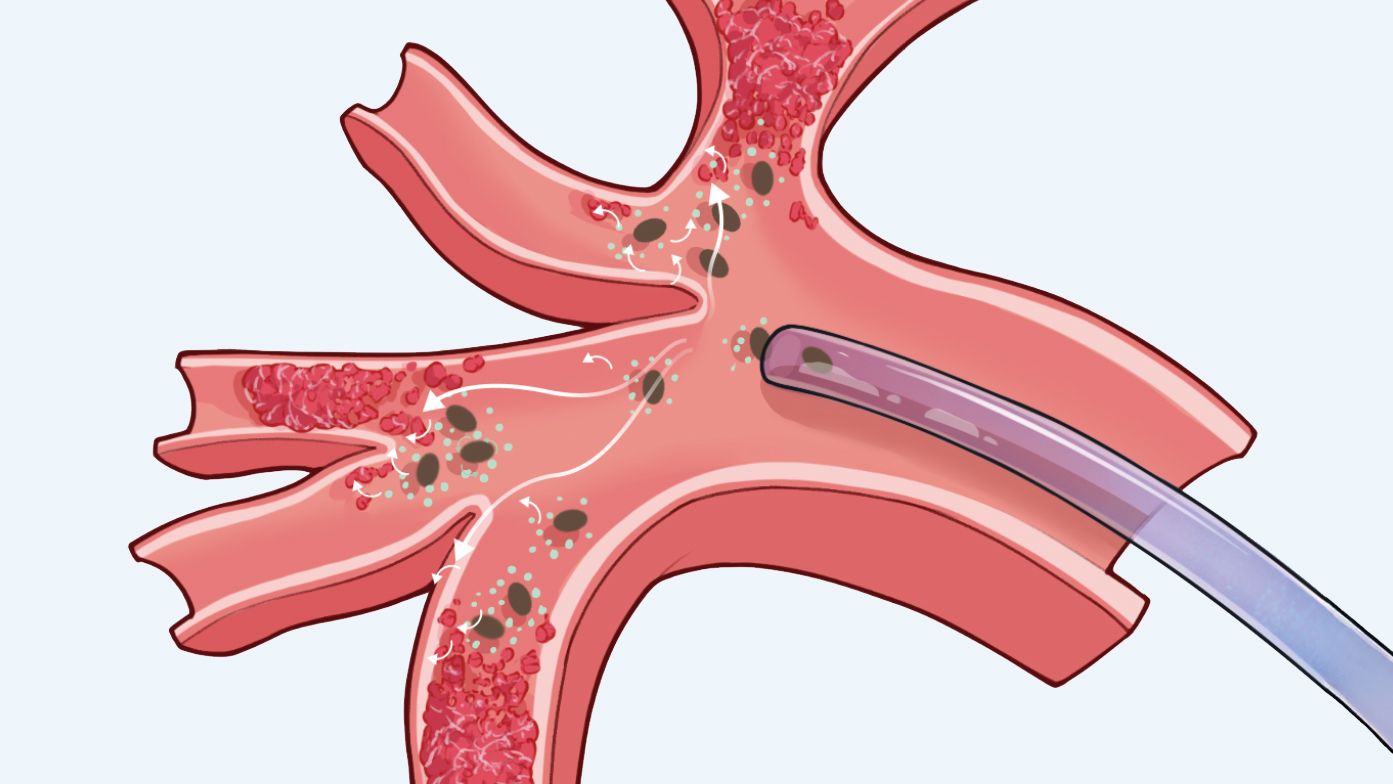 ETH News
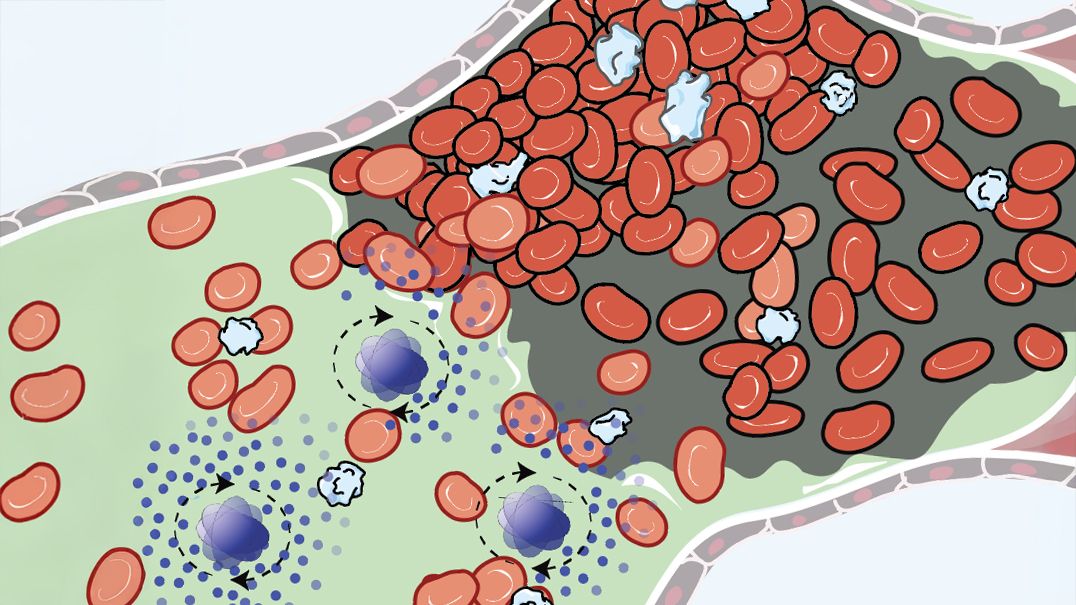 ETH News
The team first tested the microbots in a silicon model of a blood vessel that contained clots of pigs' blood. Aided by the rotating microparticles, a thrombolytic drug dissolved the blockages around 10 times faster than medication alone did. That's a potentially life-saving difference, the researchers said.
They then repeated the experiment in live pigs, placing clots in vessels in each of the animals' kidneys. "When we introduced our micro-robots with a conventional, state-of-the-art drug, we could reperfuse [restore blood flow to] a much larger area than if only the drug was there," Schürle said. "The next step is doing safety studies over a longer time and in larger animals."
Earlier safety studies in mice showed that both the iron oxide and the gel sheath polymer safely break down in the body within a few weeks. However, the team will now need to demonstrate that the device is safe in larger mammals before it can be trialed in human patients; their latest test in pigs did not look at how the device broke down or how the pigs fared after the clots were dissolved.
Ultimately, the researchers hope that the bots could be injected into the body alongside the thrombolytic medicine. Once inside, they'd be controlled by targeted electromagnets, making the technique easy to integrate into existing clinical procedures for treating clots.
The team's research is still undergoing peer review, but Schürle has applied for a patent for the microbots' production, which uses a droplet-based microfluidics technique to form each individual particle.
"It's a very cheap, high throughput method to produce the micro-robots," she said. "It's about improving the [clot-dissolving] procedure where it is lacking and helping the drugs travel the last millimeters to be really effective."
This article is for informational purposes only and is not meant to offer medical advice.
'> Tiny robots can tumble through blood vessels to help dissolve blood clots, early test shows Two Stone Age figurines — the Thinker and the Seated Woman — were discovered in a prehistoric cemetery in Romania. (Image credit: National Museum of Romanian History)QUICK FACTS
Name: Thinkers of Cernavodă
What they are: Clay figurines
Where they are from: Cernavodă, Romania
When they were made: Circa 5000 B.C.
In 1956, archaeologists unearthed two unique figurines from one grave while excavating a Stone Age cemetery in southeast Romania. The unusual figurines — known as the Thinkers of Cernavodă or the Thinker and the Seated Woman — were made by people from the Hamangia culture and may be linked to ancient astronomical beliefs.
The Thinkers of Cernavodă are in the collection of the National Museum of Romanian History and are a key part of the country's cultural heritage. They were crafted from fired clay and measure about 4.5 inches (11.5 centimeters) tall. The two figurines may represent a man (the Thinker) and a woman (the Seated Woman), according to the museum.
The Thinker sits on a low, four-legged stool. He bends forward slightly, rounding his back and neck, and his arms are bent. He rests his elbows on his knees and his head in his hands. This pose gives him a meditative quality, according to the museum, which is why he has been named after Auguste Rodin's famous 1904 bronze sculpture. The Seated Woman also has a long, bent neck and a small face. She has prominent hips, thighs and breasts. Her right leg is bent, and her hands rest on her knee.
The figurines are about 7,000 years old and were made by the Hamangia people, a Late Neolithic culture that stretched from the Danube River to the Black Sea. According to archaeologist Dumitru Berciu, who excavated the Cernavodă cemetery, the Hamangia culture lasted from about 5200 to 4500 B.C. The people focused primarily on sheep and goat herding, and they built defensive hilltop settlements. They also crafted spiral-decorated pottery and human-shaped figurines. But while Berciu found dozens of male and female figurines in the Cernavodă cemetery, he noted that both Thinkers were unusual for being depicted seated rather than standing.
The specific meaning of the Thinkers is unclear. Berciu suggested that the figurines were somewhat stylized, rather than realistic, because they served a magical or religious purpose. Since solar worship was common among later Bronze Age groups in Europe — as evidenced by artifacts like the Nebra sky disc from Germany and an ornate sun chariot from Denmark — Berciu interpreted the figurines as possibly connected to sun worship.
But the National Museum of Romanian History has suggested that the two figurines may have been made specifically as a pair, representing the complementary principles of masculine and feminine natures or a Neolithic family unit. Another interpretation is that the sculptures depict a pair of mourners who were buried with the deceased.
While the original meaning of the 7,000-year-old sculptures remains a mystery, people continue to be drawn to the contemplative pair, and the male Thinker figures prominently today in the logo of the National Museum of Romanian History.
For more stunning archaeological discoveries, check out our Astonishing Artifacts archives.
Lycurgus Cup
Mold Gold Cape
Birdman Copper Plate
Can you put together last week's Astonishing Artifact?
'> Thinkers of Cernavodă: Mysterious Stone Age figurines discovered in a 7,000-year-old grave in Romania
ultimate speed limit, takes a full 24 hours to reach it.
For researchers who worked on the Voyager program and continue to study its data, the symbolic milestone of being a full light-day from Earth celebrates a mission that continues half a century after it began. Since launching in September 1977, the twin Voyager probes have outlasted many of the engineers who built them, and their flybys of the outer solar system planets remain some of the best close-up observations scientists have of those distant worlds.
"Voyager 1 and Voyager 2 are transcending generations," Pascal Lee, a planetary scientist at the SETI Institute who was part of the Voyager 2 team at NASA's Jet Propulsion Laboratory (JPL) during its Neptune flyby in 1989, told Live Science. "Not only is their data relevant, but they themselves are still out there, moving into the unknown."
Here is what the Voyagers have revealed about the solar system and interstellar space, what happens when their power finally runs out, and whether anyone — or anything — might ever intercept the messages from Earth they carry.
How far are Voyager 1 and Voyager 2 from Earth now?
A NASA simulation showing where Voyager 1 is relative to the sun and solar system planets. (Image credit: NASA/JPL)Voyager 1, cruising through space at nearly 38,000 mph (61,000 km/h), is just shy of 16 billion miles (about 26 billion kilometers) from Earth. That's the distance light travels in 24 hours, also known as one light-day. The spacecraft will reach this milestone on Nov. 18 at 5:16:07 a.m. ET, after traveling through space for 49 years, two months and 11 days.
As long as that sounds, "it's still pathetically slow in the grand scheme of things," Lee told Live Science.
If anything, it reminds us of the sheer vastness of space and time, and how this spacecraft is just a little mote of dust that's barely drifted out of the solar system still.
Pascal Lee, Voyager 2 team member
Scientifically speaking, Voyager 1 hasn't even left its home neighborhood yet. In 2012, the probe traveled beyond the heliosphere, the bubble of plasma blown outward by the sun that shields the planets from incoming cosmic radiation. But it still remains within the sun's gravitational grasp, which extends past the Oort Cloud — a vast spherical shell of icy bodies surrounding the solar system. Voyager 1 will need about 300 more years just to reach the cloud's inner edge, and possibly 30,000 years to fly beyond it, according to NASA.
"If anything, it reminds us of the sheer vastness of space and time, and how this spacecraft is just a little mote of dust that's barely drifted out of the solar system still," Lee said.
On its current path, Voyager 1 will pass within 1.7 light-years of a dim star called Gliese 445 in about 40,000 years, at which point it will be closer to that star than to our own sun. Farther out, the nearest star system to our own, Proxima Centauri, sits about 4.24 light-years away — more than 1,500 times farther than Voyager 1 will be on Nov. 18.
Meanwhile Voyager 1's twin, Voyager 2, took a different route through the solar system after both probes launched in 1977, in order to swing past Uranus and Neptune after revisiting Jupiter and Saturn. Currently in interstellar space about 13 billion miles (21 million km) from Earth, Voyager 2 will reach its own light-day mark in November 2035, according to NASA.
What does a light-day mean for talking to Voyager 1?
An illustration of the Voyager probes passing beyond the heliopause, into interstellar space. (Image credit: NASA/JPL-Caltech)Crossing the one-light-day mark doesn't change how NASA communicates with the probe, though it does demand more patience.
NASA talks to the spacecraft using radio signals, which travel at the speed of light. At a distance of one light-day, a signal sent from Earth takes 24 hours to reach Voyager 1, and a reply takes another 24 hours to make the return journey.
"If you want to say 'hello' to Voyager, you send your message and then you go home and you wait two days before you finally get a response," Suzanne Dodd, Voyager project manager at JPL, said in a recent statement.
As the spacecraft continues to cruise deeper into space, that wait will grow longer. Moreover, 50 years of traversing the solar system and the increasing distance from our sun takes a toll on the probe itself. Because sunlight in the outer reaches is far too faint for solar panels, Voyager 1 relies on nuclear batteries that convert heat from the natural decay of plutonium into electricity. That supply is gradually dwindling, prompting NASA to gradually shut down nonessential instruments to conserve what energy remains and extend the mission as much as possible.
Kelly Perry, a data systems engineer on the Voyager program at JPL, told Live Science via email that the mission team's priority remains the same: "keep the spacecraft going as long as possible."
What have the Voyager probes taught us?
A montage of planets imaged by the twin Voyager probes, showing Jupiter, Saturn, Uranus and Neptune. (Image credit: NASA/JPL)Before the Voyagers launched, the outer solar system was largely a blur of telescopic speculation. The twin probes took advantage of a planetary alignment that comes around only once every 176 years, using the gravity of giant planets to slingshot themselves onward.
Together, they have discovered 23 moons across the outer solar system, revealed faint rings around Jupiter and captured the first detailed atmospheric profiles of Saturn, Uranus and Neptune. They also gave the first detailed, close-up views of Jupiter's moon Europa, transforming our perception of it from a blurry speck into a remarkably smooth, geologically young world — and now one of the prime candidates for finding extraterrestrial life.
We had no idea what they looked like. And all of a sudden they became places we could map, imagine ourselves exploring, landing on…they became places.
Pascal Lee, Voyager 2 team member
Among the more striking finds, Voyager 1 spotted active volcanoes on Jupiter's moon Io in 1979, the first time they had been seen on any world other than Earth.
"We had no idea what they looked like," Lee said. "And all of a sudden they became places we could map, imagine ourselves exploring, landing on…they became places," he added.
"That's what Voyager was for me — a voyage of discovery," he said.
These discoveries laid the groundwork for decades of follow-up exploration, including NASA's Galileo mission to Jupiter and the Cassini mission to Saturn. Decades later, as the only spacecraft to return in situ data from outside the heliosphere, the probes also proved that interstellar space is a dynamic, complex frontier rather than an empty vacuum.
How much time does Voyager 1 have left, and what happens when it falls silent?
Each Voyager spacecraft launched with 10 science instruments. Today, only two remain active on Voyager 1 and three on Voyager 2, measuring the magnetic fields, plasma and cosmic rays of interstellar space.
NASA began switching off the others one by one decades ago to conserve power, including the camera on Voyager 1 just minutes after it snapped the famous "Pale Blue Dot" portrait of the solar system in 1990. Ongoing power-saving reconfigurations have since helped keep the aging spacecraft operational nearly 50 years into its lifetime.
Voyager's iconic "Pale Blue Dot" image shows Earth as a "mote of dust suspended in a sunbeam," in the words of Carl Sagan. (Image credit: NASA/JPL)In one such recent effort, nicknamed the "Big Bang," engineers shut off certain high-power subsystems while switching on lower-power alternatives, which "bought us almost two more years during which we will not need to turn any instrument off," Perry said.
With onboard power steadily dwindling, however, "there's a recognition that it won't be forever," Deana Weibel, an anthropologist at the Grand Valley State University in Michigan who co-authored an upcoming book about the Golden Record aboard the Voyager probes, told Live Science.
Because Voyager is a science mission, its mission will be considered finished when "no science instruments are operational," Perry said. "The Science Team decided that the last remaining instrument will be the magnetometer," she added. "We will never intentionally power off this instrument."
After the science data eventually stops, both probes may still keep beaming back basic engineering updates, such as about their health and power status, until around 2036, according to NASA. Even after the spacecraft finally fall silent, they will keep coasting through interstellar space, and "analysis shows that they should remain intact," Perry said.
Scientists will still be able to calculate their positions based on their last known speed and trajectories, Weibel said. "We'll know intellectually where it is unless it gets intercepted."
Could an alien civilization discover the Voyager probes?
An illustration of Voyager shown next to the Golden Record. (Image credit: NASA/JPL-Caltech)Theoretically, yes. But interstellar space is so unfathomably vast that the chances of aliens finding the probes are vanishingly small, Lee said.
That makes it unlikely that aliens will ever find the Voyager Golden Records — twin gold-plated discs meant to portray the diversity of life on Earth. They hold sounds such as wind and animal calls, greetings in 55 languages, images of our planet and a celestial map pinpointing its location — all intended for a hypothetical civilization capable of retrieving and playing them. (The probes also carry visual instructions for spinning the records).
In that sense, the Golden Records are as much an artistic exercise as a scientific one.
"The chances of us going after Voyager 1 and bringing it back for the Smithsonian — not that it's likely — are more believable than any chance of an alien civilization finding it, and then playing the record," Lee said.
Knowing that Voyager will continue its mission long past my lifetime actually gives me comfort
Kelly Perry, Voyager team member
If an extraterrestrial civilization did find the probe after we lost contact with it, "we would have no way of knowing," Weibel added. "It becomes something that's powered entirely by imagination at that point."
So why send a message at all? All three scientists interviewed for this story see the Golden Record as a cosmic time capsule, a symbolic gesture meant to unite humanity around a shared home planet. For all its imperfections, including the omission of some widely spoken languages and a few mislabeled tracks, the disc remains an enduring emblem of human presence on Earth, they said.
"Knowing that Voyager will continue its mission long past my lifetime actually gives me comfort," Perry told Live Science. "Although I won't be able to speak to the Voyager spacecraft any more, I love knowing that I'll always be able to look to the stars and know they're still on their way."
'> 'Out there, moving into the unknown': As Voyager 1 reaches one light-day from Earth, scientists reflect on its past — and its future