Journal List
ID5165
Title Vaccines Research And Vaccination
E ISSN 2573-0193
P ISSN -
Country USA
Impact Factor Awaiting
Publication year 2015
Publisher NameHerald Scholarly Open Access
FrequencyAnnual
Indexed Yes
Website http://www.heraldopenaccess.us/journals/Vaccines-Research-&-Vaccination/


SIS Advertise


News

During the Scandinavian Iron Age and Viking Age (from roughly 500 B.C. to A.D. 1050), violent encounters between individuals and communities steadily increased, resulting in archaeological evidence of elite warrior burials and mass graves from battles.

To better understand the context of violence in the Iron and Viking ages, researchers analyzed 192 human bones from people buried in domestic areas at settlements in what are now Denmark, Norway and Sweden.

"The fact is that not all bodies ended up in monumental burial mounds in the Iron and Viking Ages, or even in more modest urnfields and cemeteries," the researchers wrote in a study published Sept. 28 in the Journal of Archaeological Method and Theory. Rather, some bodies — or pieces of bodies — were placed in postholes, pits, floors, wells, houses, yards and feasting halls.

The archaeologists discovered that at least 12 of the individuals had sustained a violent injury around the time of death. Half of those cases involved head trauma, while four people suffered multiple injuries. Most of the victims of violence were adult males, but there were two females and a child as well.

In one Iron Age house in Denmark, built sometime between 500 and 1 B.C., archaeologists discovered a frontal bone from the skull of a child who died between the ages of 2 and 4 years old.

four views of the frontal bone of the skull of a human child showing injuries

The skull of a child aged 2 to 4 from Aalborg, seen from different angles, and showing the damage from a sword cut. The skull was later placed on the floor of a house. (Image credit: National Museum of Denmark)

"Our DNA analyses show that it is a small boy who has been cut with a sword," study first author Marianne Hem Eriksen, an archaeologist at the National Museum of Denmark, said in a translated statement. "The child's skull was placed on the floor of a house where people continued to live. This means that someone has walked over a child's skull day after day."

Radiocarbon dating revealed that the child's skull is significantly older than the house itself, by as many as two centuries, suggesting the bone may have been kept for some time before being placed in the house floor, according to the study.

At a Viking Age site dated to around 750 to 1050, archaeologists found a young woman's skull in a well near a cluster of four small houses. "The woman's skull bore traces of blows and was buried in a well," Eriksen said. She may have been cut or slashed with a sword or ax and, like the child, her bones may have been kept for a significant amount of time before being buried in the well. "These glimpses of lives lived from the past show how fascinatingly different people must have thought about life and death," Eriksen said.

And at the Viking Age site of Gammel Lejre, a royal feasting hall that many experts consider to be the inspiration for the epic Old English poem "Beowulf," archaeologists found the burial of a man whose skeleton bore numerous blunt force injuries, several of which had healed, and which attested to a difficult and likely painful life. His skeleton was discovered directly south of the feasting hall.

The study of bones in domestic areas "opens up a completely new understanding of Iron Age society, of the occurrence of violence and of the handling of the dead," Eriksen said. "The results show a much greater complexity in the everyday life and world of imagination of the time than we often attribute to Iron Age people."

But it is unclear exactly why these particular people were the victims of violence and why they were buried in such unusual ways. One possible scenario, the researchers wrote in the study, is that these were victims of violent domestic encounters rather than warfare. Their deaths may also have been the result of socially acceptable corporal punishment or some form of aggression within the community.

Given the increase in social inequality and rise in violence in the Iron and Viking ages, the researchers suspect that precarious community members may have been targeted.

"Not all lives were equally grieved and commemorated in the Iron and Viking Ages of Scandinavia," the researchers wrote. "We may question whether some lives were already considered disposable."

See how much you know about ancient norsemen with our Viking quiz!

'> Archaeologists discover a child's skull built into the floor of a 2,500-year-old Scandinavian house Photograph 51, which was taken in May 1952 and later published to show the double-helix structure, was specifically taken for the purpose of publication — not, as some narratives have held, an experimental shot that Franklin believed was insignificant. The new research revealed that Photograph 51 was a new exposure of a sample Franklin had already photographed. She started Photograph 51 the same day she saw that photograph, Photograph 49.

"She took it because she wanted to get a really refined version," said study co-author Alistair Sponsel, a historian of science at the Science History Institute in Philadelphia. Making the effort to take a better photograph of the same sample is "a sign she knew she had something really important on her hands," Sponsel told Live Science.

Francis Crick, James Watson and Maurice Wilkins shared the Nobel Prize in Medicine for the discovery of the double-helix structure of DNA in 1962. As Watson told it in his 1968 autobiography, "The Double Helix: A Personal Account of the Discovery of the Structure of DNA," Franklin's photographs were his "aha" moment: "The black cross of reflections which dominated the picture could only arise from a helical structure," he wrote.

Rosalind Franklin (1920-1958) first took Photograph 49 and then Photograph 51, clues that she was aware of DNA's helical structure. (Image credit: Donaldson Collection via Getty Images)

Watson further implied that Franklin was a laboratory automaton, good at the X-ray crystallography techniques used to capture the images of the DNA molecule but bad at interpreting her own data. The new archival work, published Monday (Oct. 5) in the Journal of the History of Biology, suggests otherwise.

Franklin's dearth of published notes about Photograph 51 has been used to suggest she missed a major discovery. But Sponsel said her journals show she noted the possible helical shape and rich structural data in her notes for her first picture of the sample, Photograph 49, which she followed up with the more refined image in Photograph 51.

"In Franklin's mind, they were two different types of scientific image," Sponsel said. Photograph 49 was the experimental image revealing exciting new data. Photograph 51 was the showpiece to convey these findings with the most clarity and sharpness possible.

This new understanding of the relationship between the two images, and how Franklin perceived them, is the most important feature of the new work, Sponsel said, which he conducted with molecular biophysicist Brian Sutton of King's College London. The project began when the Science History Institute acquired a new collection of archival material from Rosalind Franklin and her graduate student Raymond Gosling. The two researchers also combed through the archives at King’s College London, where Franklin was working when she took the famous photos.

Sponsel and Sutton think that Franklin's notes and actions reveal why she didn't rush to publish Photograph 51 right away. Her scientific goals, laid out in a report she wrote in February 1952, were to understand the two separate structures of DNA, then known as A and B. Structure B, illustrated in Photographs 49 and 51, turned out to be the double helix that occurs in nature. Structure A is a form DNA takes when it's dehydrated in the lab.

Structure A, when photographed, appeared more data-rich, so Franklin decided to characterize that structure first before studying structure B. But while she did this painstaking work, Wilkins showed Watson her photographs of structure B. The two scientists, together with Crick, then built a detailed model of DNA's double helix and scooped the discovery from under her nose.

Those three men shared the Nobel Prize for the work less than a decade later. Franklin died of ovarian cancer in 1958, making her ineligible for the prize — and leaving her insights to come to light only much later.

Editor's note: This article was updated at 3:23 p.m. ET to fix the caption and subhead, noting that Rosalind Franklin had likely discovered DNA's helical, but not double-helix structure. Also, the top photo is not Photograph 51, but another photo taken by Franklin.

'> 'She knew she had something really important on her hands': Rosalind Franklin figured out DNA's helical structure before Watson and Crick, study s...

Fall is a fantastic time to stargaze, with meteor showers, full moons, constellations and planetary oppositions — some of which you can only see with binoculars or a telescope. Shop the best deals on telescopes and binoculars below.

Telescope deals

If you want a small, easy-to-use smart telescope with minimal investment, you can save $99 on the ZWO Seestar S30.

These small smart telescopes are ideal for deep-sky astrophotography, particularly for large nebulas and galaxies like the North America Nebula and the Andromeda Galaxy. They're an easy introduction to astrophotography, and you can also photograph the Moon and Sun, too.

Although we haven't reviewed this exact model, you can read our review of the S30 Pro, which we named the best portable smart telescope.View Deal

If you want a portable smart telescope that excels at wide-angle shooting, the Dwarf Mini is the ideal choice, and you can save $59 right now at Amazon.

Its portability is the killer feature here, as it's around half the weight of the Seestar S30 we mentioned above. Plus, the wide-angle camera is much wider, making it better for Milky Way landscapes, constellations and bigger portions of the sky.

Read our full Dwarflab Dwarf Mini reviewView Deal

Celestron AstroMaster 70AZ: was $199.95 now $151.9
This small, portable Celestron telescope is ideal for beginners and younger users who want a closer look at the Moon and planets.

Not to be confused with the Celestron AstroMaster LT 70AZ, which is smaller and gives you a slightly wider view. The standard AstroMaster 70AZ, which is on offer here, has a longer focal length, which is better suited to spotting planets, particularly Jupiter and Saturn. This telescope usually sits around $179, and this is the cheapest we've seen it since June.View Deal

Celestron StarSense Explorer LT 80AZ: was $249.95 now $199.99
The Celestron StarSense range is really useful for total beginners, as the smartphone dock and accompanying app work out where the telescope is pointing, then show arrows on the screen to guide you towards certain objects.

So, rather than "Here's a telescope, good luck finding Jupiter", the StarSense is much more "Here's what's visible tonight. Pick something, and I'll show you where it is".

If you can afford to stretch your budget, this is a better option than the AstroMaster 70LT we listed above. It has better light-gathering capabilities thanks to the wider aperture; it's a lighter package overall and it includes a 2x Barlow lens.

We've not reviewed the 80mm aperture model, but we do have a full Celestron StarSense Explorer LT 70AZ review.View Deal

If you're looking for more of an intermediate-level telescope, the Celestron AstroMaster 130EQ-MD is a great option, and you can save $58 right now.

The EQ mount has a bit of a learning curve, but once you've got it set up, it's a much more accurate way of tracking objects across the night sky. Plus, this version comes with a motor drive, so there's no manual adjusting needed.

The 130mm aperture is great for viewing brighter deep-sky objects, and the moon looks beautiful, as do Jupiter and Saturn. View Deal

Celestron NexStar 102SLT: was $639.95 now $479.99
If you like the intelligence of a smart telescope but want an observational telescope, a GoTo is the perfect combination. Once the telescope is aligned, you use the handset to select a celestial object from the list, and the telescope automatically orients itself toward your chosen object.

This telescope has a 102mm aperture, which is excellent for observing larger deep-sky objects, the moon, and planets. It's user-friendly without feeling too much like a beginner telescope, and it's an excellent price.View Deal

Binocular deals

These massive, powerful astronomy binoculars are the closest thing to a telescope that isn't actually a telescope. With 25x magnification and 100mm objective lens diameter, they're perfect for getting detailed views of the moon and night sky.

Be warned, they're very big and very heavy, so you'll need to mount them on a tripod. They're for dedicated astronomy users, so if you want something lightweight and portable, check out some of the other options in this guide.

Read our full Celestron SkyMaster 25x100 reviewView Deal

If you're looking for astronomy binoculars on a budget, these 12x60s from Celestron are ideal. They're a little big to use handheld, but they'll give you great views of the moon and stars, and you'll be able to spot Jupiter's moons.

Read our full Celestron SkyMaster 12x60 reviewView Deal

Celestron Nature DX ED 12x50: was $279.95 now $234.99
Binoculars with viewing power and excellent optical quality. These binoculars have ED glass to eliminate chromatic aberration, which is particularly useful when viewing the moon. They're more of an investment than non-ED glass, but they're worth every cent and will last a long time.

We've not reviewed this exact variant, but we have a full review of the smaller Celestron Nature DX ED 10x42.View Deal

The Celestron Regal ED 10x42 is one of the best multi-use binoculars we've tested. The ED glass and field-flattening technology produce clear, sharp views across the entire frame, and the 10x42 spec is good for spotting wildlife and sweeping across the sky to get a closer look at the moon and stars.

Read our full Celestron Regal ED 10x42 reviewView Deal

'> Amazon Prime Big Deal Days 2026: Best stargazing deals on telescopes and binoculars A "sunglint" transforming a reservoir into a giant silver river

Who took the photo? An unnamed astronaut on board the International Space Station

When was it taken? 2016

This eye-catching astronaut photo mosaic shows a rare "sunglint" transforming a snaking reservoir into a giant silver river.

The winding waterway at the heart of this image is a section of Lake Powell in southern Utah. The artifical reservoir starts around 70 miles (110 kilometers) southwest of the town of Moab and ends roughly 60 miles (100 km) northeast of the Grand Canyon in Arizona. When full, Lake Powell holds up to 1.2 billion cubic feet (33.3 million cubic meters) of water, making it the second-largest reservoir in the U.S. — close behind the nearby Lake Mead, which stretches across the Arizona-Nevada border.

Lake Powell is located on the Colorado River, inside a steep ravine known as Glen Canyon. The reservoir emerged in the 1960s, following the construction of the Glen Canyon Dam, which caused water levels to rise by around 200 feet (60 meters) over the next two decades. In addition to generating hydroelectric power, the artificial lake has become a popular tourist destination. (Lake Mead is also located along the Colorado River and was created by the construction of the Hoover Dam.)

This image mosaic, which stitches together several astronaut photos into a single image, was captured during a sunglint, according to NASA's Earth Observatory. This phenomenon occurs when sunlight bounces off a reflective surface directly into the line of sight of an observer in orbit, such as a satellite or an astronaut, giving the object a metallic, mirror-like gleam.

Normally, this effect would be visible only across a small section of the lake. But by combining photos taken as the sunglint moved along the reservoir's length, the entire body of water was illuminated.

A photo of the Glen Canyon Dam

Lake Powell was created by the Glen Canyon Dam in northern Arizona. It took around 17 years for the reservoir to fully fill after the barrier's construction was completed in 1966. (Image credit: Adbar via Wikimedia)

The reservoir is named after John Wesley Powell, an explorer and former director of the U.S. Geological Survey, who mapped out Glen Canyon and other parts of the Colorado River in the late 1860s. Powell was particularly captivated by Glen Canyon, which contained a "labyrinth of overhanging cliffs, hanging gardens, sweeping river bends, and natural arches set amidst a backdrop of colorful buttes and mesas," Earth Observatory representatives wrote.

Powell later described his recollections of the canyon. "Past these towering monuments, past these mounded billows of orange sandstone, past these oak-set glens, past these fern-decked alcoves, past these mural curves, we glide hour after hour, stopping now and then, as our attention is arrested by some new wonder," Powell wrote in his 1875 book "Canyons of the Colorado."

Some of the sights that Powell marveled over still exist, including many smaller canyons that branch off the reservoir and are cast in deep shadow. A similar effect is seen in sections of Utah's Green River, a tributary of the Colorado River that has long perplexed geologists due to its ability to flow "uphill."

From above, one of the canyon's most striking geological features ‪—‬ a large, doughnut-shaped depression known as The Rincon ‪—‬ is visible as a dark ring surrounding a bend along one of the widest sections of the lake. This rusty doughnut, which is up to 3 miles (5 km) across, is a former section of the Colorado River that dried out thousands of years ago when part of the canyon collapsed, enabling water to bypass the rocky loop.

A photo of the Colorado River in the Glen Canyon

Glen Canyon is home to many geological features that have since been submerged by Lake Powell. This photo shows a section of the canyon downstream from the dam, where these features are still mostly exposed. (Image credit: Vicki Jauron, Babylon and Beyond Photography via Getty Images)

However, many of the other wonders that Powell described have been lost beneath the reservoir's elevated water level. These include a side canyon dubbed the Music Temple, which was shaped in a way that gave it remarkable acoustic properties, according to the Earth Observatory.

During periods of drought, when the reservoir's water levels temporarily drop, other lost geological treasures can be exposed. For example, in 2023, researchers found rare fossils from a mammal-like Jurassic creature lurking beneath the lake's high-water line.

In recent years, some environmental groups have petitioned to drain Lake Powell and return Glen Canyon to its former glory as the "heart of the Colorado River," according to Newsweek. Such a change may help to alleviate pressure on the rest of the river, which has lost a significant amount of water in recent decades. But experts told Newsweek that this is unlikely to happen.

See more Earth from space

An astronaut photo showing two lakes separated by a narrow strip of land

Pair of Patagonian lakes meet

A 2020 astronaut photo shows the unusual point where two contrastingly colored Patagonian lakes meet. The duo was originally a single body of water but was split by a narrow land bridge.

An astronaut photo of a section of a lake half covered in fracturing ice

World's highest frozen lake shatters

A 2024 astronaut photo shows the icy surface of Pangong Lake breaking apart in the lofty Tibetan Plateau. The point where the ice meets the water almost perfectly matches a disputed border between China and India.

A satellite photo showing a massive green lake in the Australian outback

Ghostly lakes merge in Australia

A 2024 satellite photo shows a series of ephemeral lakes that merged into a single emerald structure in Australia's Northern Territory following two years of extreme rainfall.

'> Lost 'heart' of the Colorado River shines like a silver serpent in Utah

Today, many countries affected by that outbreak — including Germany, Portugal and the United States — are still contending with local mpox transmission. Here's what to know about the virus, how it spreads and how to prevent infection.

What to know about mpox in the U.S.

Mpox is still spreading at low levels in the United States and may soon be considered endemic to the country. While case counts have fallen dramatically since the peak of the global outbreak in summer 2022, some people are still advised to get vaccinated against the virus.

Who should get vaccinated for mpox?

The mpox vaccine currently used in the U.S. is called JYNNEOS. One dose is about 35% to 86% effective, while the complete two-dose series is 66% to 90% effective. (The effectiveness varies, in part, because some studies include people with HIV and people without HIV, and inadequately treated HIV can undermine the body's response to vaccines.)

The JYNNEOS vaccine is not currently recommended for routine use in the general population because, beyond vulnerable groups, the risk is not high enough to warrant a universal vaccination strategy. The current outbreak is primarily affecting men who have sex with men, and those sexual networks are the primary targets for JYNNEOS vaccination.

However, not all men who have sex with men need to be vaccinated, according to the Centers for Disease Control and Prevention (CDC). Instead, vaccination is recommended for a specific subset of the group, including those who, in the last six months, have had more than one sex partner, have had sex at commercial sex venues, or have been diagnosed with other sexually transmitted diseases.

Nonbinary and transgender people with these risk factors are also recommended to get two doses of JYNNEOS, as are any sexual partners of anyone in the above groups.

Vaccines are also recommended after a suspected exposure to mpox, as they can help prevent or reduce the severity of the infection.

"For those who are eligible and have not yet completed vaccination, now is a good time to talk with a healthcare provider about getting protected," Dr. Demetre Daskalakis, chief medical officer of Callen-Lorde, an LGBTQ+ community health center in New York City, told Live Science in an email.

With the exception of laboratory researchers who work with mpox, people who have received two doses of JYNNEOS are fully vaccinated and do not need a booster, he said. And if a person has caught mpox in the past and recovered, they do not need to get a vaccine, he added.

close up of a health care worker's gloved hands as they draw the jynneos vaccine out of a vial and into a syringe

Individuals who are recommended to get vaccinated against mpox should get two doses of the JYNNEOS vaccine. (Image credit: PATRICK T. FALLON/AFP via Getty Images)

About the virus

The poxvirus family also includes smallpox, which has been eradicated worldwide. Mpox and smallpox cause some similar symptoms, but mpox tends to be far milder than smallpox. However, the viruses are closely related enough that vaccines designed to prevent smallpox can also protect against mpox.

Mpox was initially named monkeypox because the virus behind the disease was discovered in captive monkeys in Denmark. But monkeys are not the main hosts of the virus in the wild; rodents and small mammals mostly found in West and Central Africa likely are. Health officials changed the name to mpox in 2022.

There are two major branches of the mpox family tree, called clade I and clade II. These clades were historically thought to have very different death rates, with clade I being the deadlier of the two. The case-fatality rate (CFR) of clade I has been estimated to range from 1.4% to over 10%, depending on the outbreak, while the CFR for clade II has been estimated at between 0.1% and 3.6%.

However, as both clades have spread beyond Africa, data suggests that the CFR for clade I may be lower than once thought, said Joel Wertheim, a professor of medicine in the Division of Infectious Diseases and Global Public Health at the University of California, San Diego.

The features of a given outbreak — such as the surrounding health infrastructure, patients' access to timely medical care, and the population's underlying risk factors for severe disease — likely play a big role in determining the virus's death toll, Wertheim told Live Science. In short, rather than being an immutable feature of the virus itself, the CFR is dependent on the underlying health of and resources available to a given population.

How mpox spreads

Mpox can spread from infected animals to humans through the animals' bites or scratches. Additionally, people can get the virus when they come into close contact with animals and/or their bodily fluids during hunting, skinning, trapping, cooking, eating animals or handling carcasses, the World Health Organization (WHO) notes.

The virus also spreads from person to person, primarily through very close contact, including intimate contact during sex. The virus typically enters the body through broken skin, the respiratory tract or mucous membranes (thin tissues found in the eyes, nose, mouth, anus and genitals), spreading via bodily fluids such as spit, mucus or blood. People can also pick up the virus via objects, such as clothing or linen, that are contaminated with the bodily fluids of an infected person.

The virus can spread through small respiratory droplets expelled during speaking or breathing. However, this is thought to be a less-common transmission route than close contact. There is also evidence that asymptomatic spread sometimes occurs, though it's unclear how frequently that happens.

Mpox can spread from mother to baby during pregnancy or birth. This route of infection can result in pregnancy loss, stillbirth, death of the newborn, or complications for the mother.

Symptoms of mpox
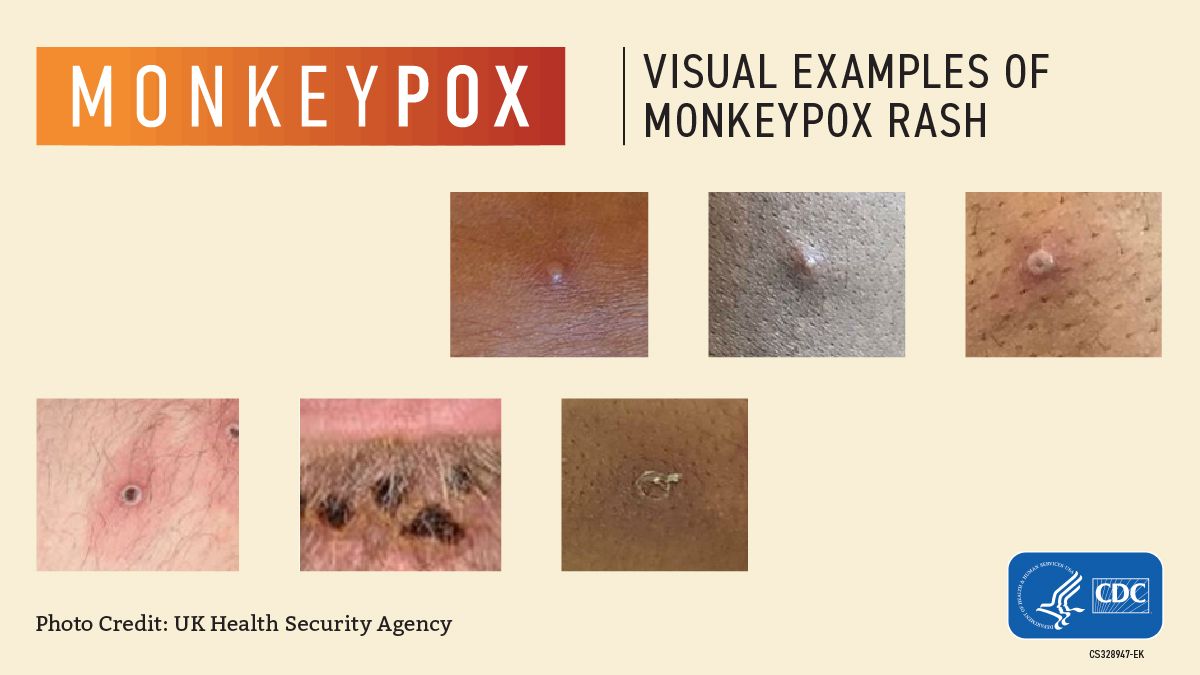
text across the top reads:
Centers for Disease Control and Prevention, National Center for Emerging and Zoonotic Infectious Diseases (NCEZID), Division of High-Consequence Pathogens and Pathology (DHCPP)
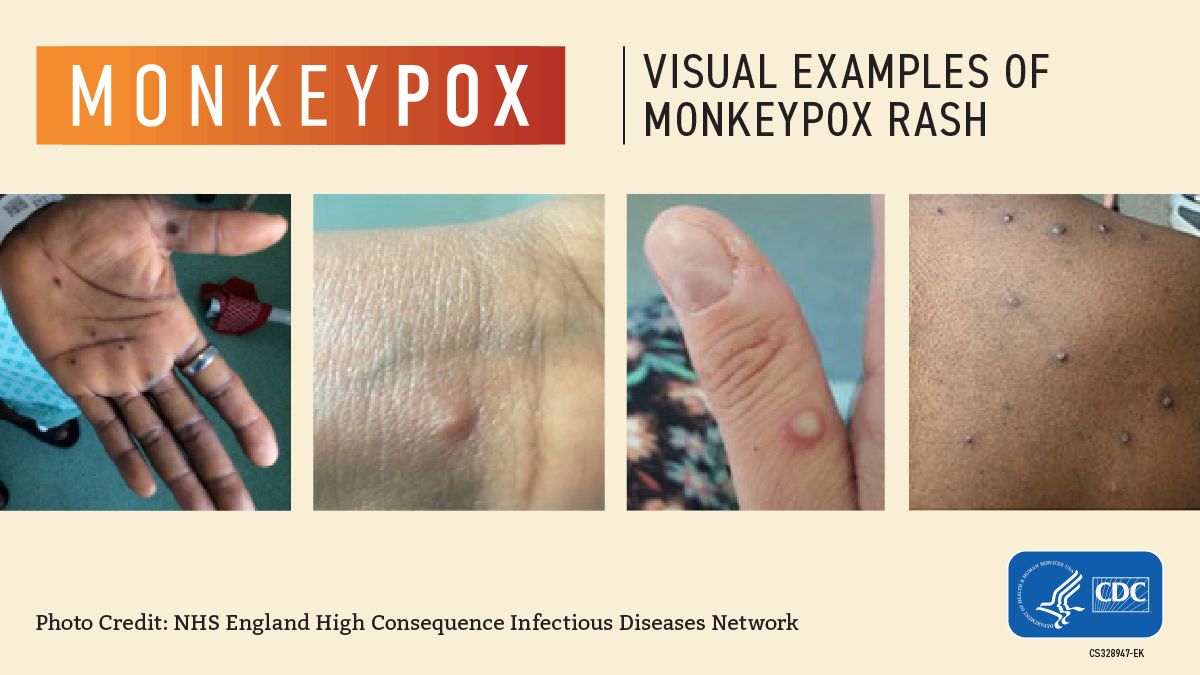
a graphic that reads
Centers for Disease Control and Prevention, National Center for Emerging and Zoonotic Infectious Diseases (NCEZID), Division of High-Consequence Pathogens and Pathology (DHCPP)

Symptoms of mpox typically appear within a week of a person being exposed to the virus, but they can sometimes take up to 21 days to develop. Once they emerge, symptoms last about two to four weeks, although the illness can linger longer in people with weakened immune systems.

Common symptoms include rash (see images), fever, sore throat, headache, muscle aches, back pain, swollen lymph nodes and low energy. Often, mpox rashes first appear on the face and then spread to other parts of the body; however, if a person becomes infected during sex, the rash may instead start around their genitals. The rashes begin as flat, discolored patches of skin and then progress into raised bumps, blisters, and large, pus-filled pimples that eventually scab over and fall off.

Some people with mpox develop painful swelling of the rectum (proctitis), while others have pain and difficulty when peeing (dysuria) or when swallowing.

Mpox rashes can make people vulnerable to bacterial skin infections, which can cause abscesses or other serious skin damage. Additional complications of the illness include pneumonia, infection of the cornea that can cause vision loss, and vomiting and diarrhea that causes dehydration or malnutrition. Mpox can also lead to blood infections, the intense immune reaction sepsis and, rarely, brain infections (encephalitis) or heart inflammation (myocarditis).

Children, pregnant people, and people with weakened immune systems, including from HIV infection, have a higher risk of serious illness and death from mpox.

Mpox prevention measures

Beyond vaccination, other strategies to decrease the risk of mpox infection include washing hands frequently, avoiding contact with contaminated objects and materials used by people with mpox, avoiding contact with other people's scabs or rashes, and using condoms, although they may only reduce, not eliminate, the risk of mpox exposure during sex.

Mpox treatment

Mpox treatment aims to manage a person's rashes and pain while also preventing complications. "Early and supportive care is important to help manage symptoms and avoid further problems," according to the WHO.

There is no antiviral drug approved for use in mpox, although some are available for emergency use in various countries. For example, the U.S. allows the use of certain smallpox medicines for mpox.

Severe mpox infections also may be treated with vaccinia immune globulin intravenous, which contains antibodies taken from the blood of people who were immunized against smallpox.

People who have recently been exposed to mpox can be given an mpox vaccine to reduce the severity of their symptoms or to prevent the illness altogether. This approach is known as post-exposure prophylaxis, or PEP.

"Post-exposure vaccine should be given as soon as possible, ideally within 4 days of exposure; administration 4 through 14 days after exposure may still provide some protection against monkeypox," the CDC states.

'> Mpox is still spreading in the US — here's what to know about vaccines, symptoms and treatment
Visits
Online User :
Today Visit :
Week Visit :
Month Visit :
Total Visit :
  • © 2013-2026
  • |
  • Scientific Indexing Services
3505 Brewster Drive, Plano, Texas, 75025, USA