This eye-catching astronaut photo mosaic shows a rare "sunglint" transforming a snaking reservoir into a giant silver river.
The winding waterway at the heart of this image is a section of Lake Powell in southern Utah. The artifical reservoir starts around 70 miles (110 kilometers) southwest of the town of Moab and ends roughly 60 miles (100 km) northeast of the Grand Canyon in Arizona. When full, Lake Powell holds up to 1.2 billion cubic feet (33.3 million cubic meters) of water, making it the second-largest reservoir in the U.S. — close behind the nearby Lake Mead, which stretches across the Arizona-Nevada border.
Lake Powell is located on the Colorado River, inside a steep ravine known as Glen Canyon. The reservoir emerged in the 1960s, following the construction of the Glen Canyon Dam, which caused water levels to rise by around 200 feet (60 meters) over the next two decades. In addition to generating hydroelectric power, the artificial lake has become a popular tourist destination. (Lake Mead is also located along the Colorado River and was created by the construction of the Hoover Dam.)
The reservoir is named after John Wesley Powell, an explorer and former director of the U.S. Geological Survey, who mapped out Glen Canyon and other parts of the Colorado River in the late 1860s. Powell was particularly captivated by Glen Canyon, which contained a "labyrinth of overhanging cliffs, hanging gardens, sweeping river bends, and natural arches set amidst a backdrop of colorful buttes and mesas," Earth Observatory representatives wrote.
Powell later described his recollections of the canyon. "Past these towering monuments, past these mounded billows of orange sandstone, past these oak-set glens, past these fern-decked alcoves, past these mural curves, we glide hour after hour, stopping now and then, as our attention is arrested by some new wonder," Powell wrote in his 1875 book "Canyons of the Colorado."
Some of the sights that Powell marveled over still exist, including many smaller canyons that branch off the reservoir and are cast in deep shadow. A similar effect is seen in sections of Utah's Green River, a tributary of the Colorado River that has long perplexed geologists due to its ability to flow "uphill."
From above, one of the canyon's most striking geological features — a large, doughnut-shaped depression known as The Rincon — is visible as a dark ring surrounding a bend along one of the widest sections of the lake. This rusty doughnut, which is up to 3 miles (5 km) across, is a former section of the Colorado River that dried out thousands of years ago when part of the canyon collapsed, enabling water to bypass the rocky loop.
However, many of the other wonders that Powell described have been lost beneath the reservoir's elevated water level. These include a side canyon dubbed the Music Temple, which was shaped in a way that gave it remarkable acoustic properties, according to the Earth Observatory.
During periods of drought, when the reservoir's water levels temporarily drop, other lost geological treasures can be exposed. For example, in 2023, researchers found rare fossils from a mammal-like Jurassic creature lurking beneath the lake's high-water line.
In recent years, some environmental groups have petitioned to drain Lake Powell and return Glen Canyon to its former glory as the "heart of the Colorado River," according to Newsweek. Such a change may help to alleviate pressure on the rest of the river, which has lost a significant amount of water in recent decades. But experts told Newsweek that this is unlikely to happen.
'> Lost 'heart' of the Colorado River shines like a silver serpent in Utah
Today, many countries affected by that outbreak — including Germany, Portugal and the United States — are still contending with local mpox transmission. Here's what to know about the virus, how it spreads and how to prevent infection.
What to know about mpox in the U.S.
Mpox is still spreading at low levels in the United States and may soon be considered endemic to the country. While case counts have fallen dramatically since the peak of the global outbreak in summer 2022, some people are still advised to get vaccinated against the virus.
Who should get vaccinated for mpox?
The mpox vaccine currently used in the U.S. is called JYNNEOS. One dose is about 35% to 86% effective, while the complete two-dose series is 66% to 90% effective. (The effectiveness varies, in part, because some studies include people with HIV and people without HIV, and inadequately treated HIV can undermine the body's response to vaccines.)
The JYNNEOS vaccine is not currently recommended for routine use in the general population because, beyond vulnerable groups, the risk is not high enough to warrant a universal vaccination strategy. The current outbreak is primarily affecting men who have sex with men, and those sexual networks are the primary targets for JYNNEOS vaccination.
However, not all men who have sex with men need to be vaccinated, according to the Centers for Disease Control and Prevention (CDC). Instead, vaccination is recommended for a specific subset of the group, including those who, in the last six months, have had more than one sex partner, have had sex at commercial sex venues, or have been diagnosed with other sexually transmitted diseases.
Nonbinary and transgender people with these risk factors are also recommended to get two doses of JYNNEOS, as are any sexual partners of anyone in the above groups.
Vaccines are also recommended after a suspected exposure to mpox, as they can help prevent or reduce the severity of the infection.
"For those who are eligible and have not yet completed vaccination, now is a good time to talk with a healthcare provider about getting protected," Dr. Demetre Daskalakis, chief medical officer of Callen-Lorde, an LGBTQ+ community health center in New York City, told Live Science in an email.
With the exception of laboratory researchers who work with mpox, people who have received two doses of JYNNEOS are fully vaccinated and do not need a booster, he said. And if a person has caught mpox in the past and recovered, they do not need to get a vaccine, he added.
Individuals who are recommended to get vaccinated against mpox should get two doses of the JYNNEOS vaccine. (Image credit: PATRICK T. FALLON/AFP via Getty Images)About the virus
The poxvirus family also includes smallpox, which has been eradicated worldwide. Mpox and smallpox cause some similar symptoms, but mpox tends to be far milder than smallpox. However, the viruses are closely related enough that vaccines designed to prevent smallpox can also protect against mpox.
Mpox was initially named monkeypox because the virus behind the disease was discovered in captive monkeys in Denmark. But monkeys are not the main hosts of the virus in the wild; rodents and small mammals mostly found in West and Central Africa likely are. Health officials changed the name to mpox in 2022.
There are two major branches of the mpox family tree, called clade I and clade II. These clades were historically thought to have very different death rates, with clade I being the deadlier of the two. The case-fatality rate (CFR) of clade I has been estimated to range from 1.4% to over 10%, depending on the outbreak, while the CFR for clade II has been estimated at between 0.1% and 3.6%.
However, as both clades have spread beyond Africa, data suggests that the CFR for clade I may be lower than once thought, said Joel Wertheim, a professor of medicine in the Division of Infectious Diseases and Global Public Health at the University of California, San Diego.
The features of a given outbreak — such as the surrounding health infrastructure, patients' access to timely medical care, and the population's underlying risk factors for severe disease — likely play a big role in determining the virus's death toll, Wertheim told Live Science. In short, rather than being an immutable feature of the virus itself, the CFR is dependent on the underlying health of and resources available to a given population.
How mpox spreads
Mpox can spread from infected animals to humans through the animals' bites or scratches. Additionally, people can get the virus when they come into close contact with animals and/or their bodily fluids during hunting, skinning, trapping, cooking, eating animals or handling carcasses, the World Health Organization (WHO) notes.
The virus also spreads from person to person, primarily through very close contact, including intimate contact during sex. The virus typically enters the body through broken skin, the respiratory tract or mucous membranes (thin tissues found in the eyes, nose, mouth, anus and genitals), spreading via bodily fluids such as spit, mucus or blood. People can also pick up the virus via objects, such as clothing or linen, that are contaminated with the bodily fluids of an infected person.
The virus can spread through small respiratory droplets expelled during speaking or breathing. However, this is thought to be a less-common transmission route than close contact. There is also evidence that asymptomatic spread sometimes occurs, though it's unclear how frequently that happens.
Mpox can spread from mother to baby during pregnancy or birth. This route of infection can result in pregnancy loss, stillbirth, death of the newborn, or complications for the mother.
Symptoms of mpox
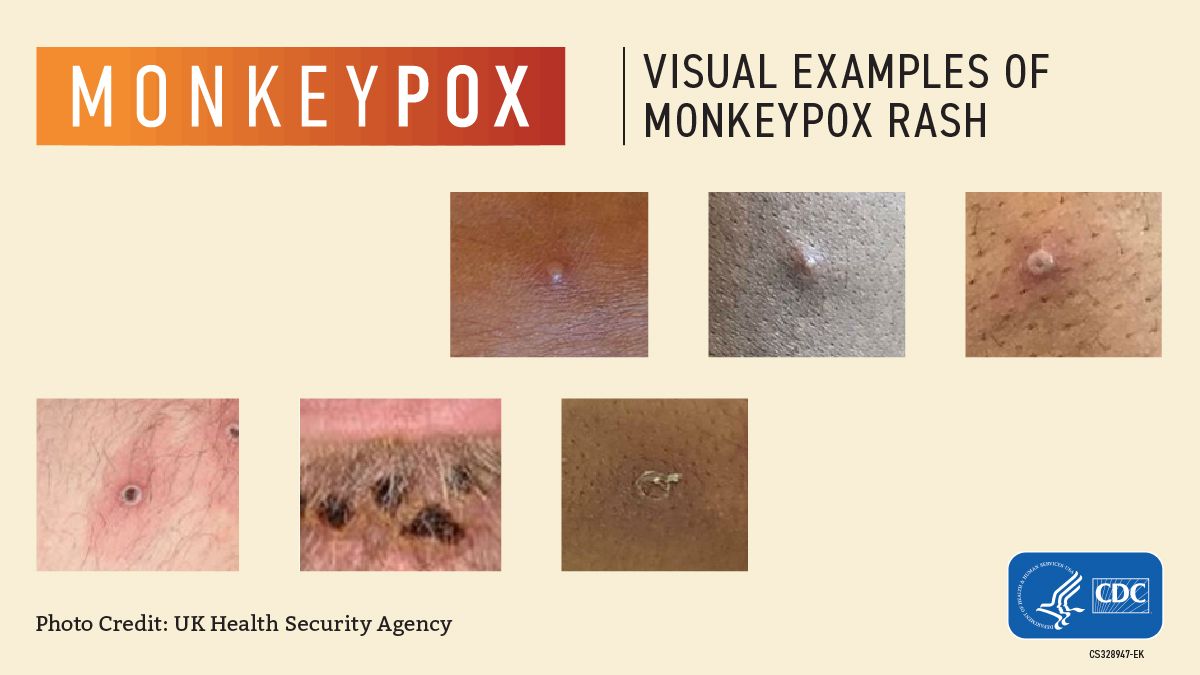 Centers for Disease Control and Prevention, National Center for Emerging and Zoonotic Infectious Diseases (NCEZID), Division of High-Consequence Pathogens and Pathology (DHCPP)
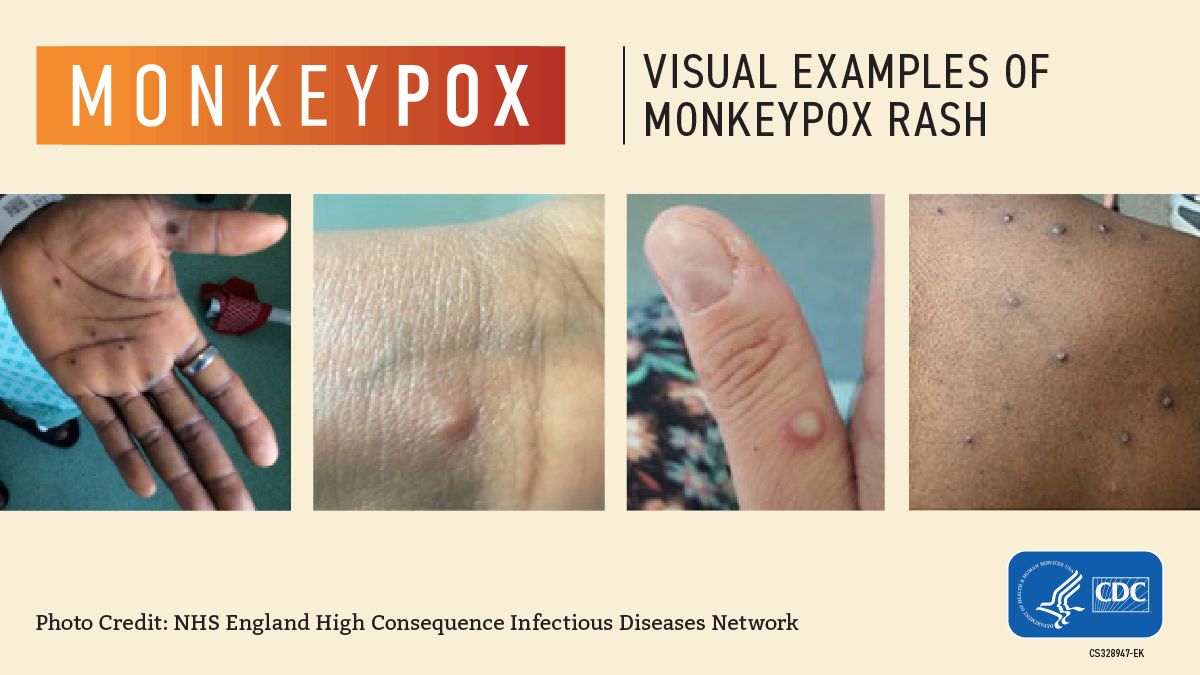 Centers for Disease Control and Prevention, National Center for Emerging and Zoonotic Infectious Diseases (NCEZID), Division of High-Consequence Pathogens and Pathology (DHCPP)
Symptoms of mpox typically appear within a week of a person being exposed to the virus, but they can sometimes take up to 21 days to develop. Once they emerge, symptoms last about two to four weeks, although the illness can linger longer in people with weakened immune systems.
Common symptoms include rash (see images), fever, sore throat, headache, muscle aches, back pain, swollen lymph nodes and low energy. Often, mpox rashes first appear on the face and then spread to other parts of the body; however, if a person becomes infected during sex, the rash may instead start around their genitals. The rashes begin as flat, discolored patches of skin and then progress into raised bumps, blisters, and large, pus-filled pimples that eventually scab over and fall off.
Some people with mpox develop painful swelling of the rectum (proctitis), while others have pain and difficulty when peeing (dysuria) or when swallowing.
Mpox rashes can make people vulnerable to bacterial skin infections, which can cause abscesses or other serious skin damage. Additional complications of the illness include pneumonia, infection of the cornea that can cause vision loss, and vomiting and diarrhea that causes dehydration or malnutrition. Mpox can also lead to blood infections, the intense immune reaction sepsis and, rarely, brain infections (encephalitis) or heart inflammation (myocarditis).
Children, pregnant people, and people with weakened immune systems, including from HIV infection, have a higher risk of serious illness and death from mpox.
Mpox prevention measures
Beyond vaccination, other strategies to decrease the risk of mpox infection include washing hands frequently, avoiding contact with contaminated objects and materials used by people with mpox, avoiding contact with other people's scabs or rashes, and using condoms, although they may only reduce, not eliminate, the risk of mpox exposure during sex.
Mpox treatment
Mpox treatment aims to manage a person's rashes and pain while also preventing complications. "Early and supportive care is important to help manage symptoms and avoid further problems," according to the WHO.
There is no antiviral drug approved for use in mpox, although some are available for emergency use in various countries. For example, the U.S. allows the use of certain smallpox medicines for mpox.
Severe mpox infections also may be treated with vaccinia immune globulin intravenous, which contains antibodies taken from the blood of people who were immunized against smallpox.
People who have recently been exposed to mpox can be given an mpox vaccine to reduce the severity of their symptoms or to prevent the illness altogether. This approach is known as post-exposure prophylaxis, or PEP.
"Post-exposure vaccine should be given as soon as possible, ideally within 4 days of exposure; administration 4 through 14 days after exposure may still provide some protection against monkeypox," the CDC states.
'> Mpox is still spreading in the US — here's what to know about vaccines, symptoms and treatment