" for translating coded historical messages.
"I didn't believe it at first," Church told Live Science in a message. "Everyone has the experience of seeing a model claim something outrageous, but the difference here though is that the solution is mechanically testable: there's essentially zero chance an incorrect key could produce coherent and historically consistent output."
The letter was sent in 1809 on Napoleon's request by his stepson Eugène, the viceroy of Italy, to Marshal Auguste de Marmont, who was stationed far from any other French troops on the eastern shore of the Adriatic Sea. The letter's purpose was to tell Marmont the position of every other French and allied army across the continent. However, to avoid revealing military secrets to France's enemies should the letter be intercepted, the message was written in code.
Church found the letter after searching for an appropriate code to break to demonstrate GPT-6 Astra's capabilities. "The verifiability of solutions is actually the most difficult part, far more difficult than generating potential solutions," Church said. "You simply cannot automate accountability."
But this low resolution scan and a single prompt was all GPT-6 Astra needed to transcribe the text and find a partial table by cryptology historian Daniel Tant — previously unlinked to this letter — that documented what 33 of the symbols meant, accounting for about a third of the letter.
"Astra made this connection itself via web research as it was investigating," Church said. "As I understand it: Tant catalogued the table as 'Code entre Eugène de Beauharnais et le Général Grammont' which may have been a naming mistake (Grammont vs Marmont?). Either way, Astra identified this example and just decided to try and apply it to this cipher...and it worked!"
GPT-6 successfully used the partial table to determine what each of the other symbols stood for and translate the message.
"It's a bit like a kind of Rosetta Stone," Rowe told Live Science. "If you've tested out AI on this letter, where you pretty much know what the contents would have been because it's referred to in another letter, the AI does its thing and essentially reproduces what you're expecting to see. Then if you use the exact same kind of tool and methodology on something where you don't know [the contents], you're more likely to trust the outcome."
This does also mean that the translation of Eugène's secret message isn't too surprising to historians. "The cipher version just repeated a large segment of what's in that [original] letter, so in a sense it doesn't tell us anything new — it's not like it reveals some kind of great new information," Rowe said.
In addition to the positions of troops and their commanders, Eugène's message encourages Marmont not to fear opposition: "When you receive the order to march, you must not allow yourself to be intimidated by a few troops or a gathering of rabble," the newly-translated letter reads.
According to White, the translation does raise "some curious questions about Napoleon's mindset in the run up to the campaign in Austria in 1809." For example, he said that Napoleon actually had 60,000 fewer troops available to fight at the time than is claimed in this letter, and he also seems fixated on the number of troops Austria might send to invade Italy.
"It's important that historians now set the AI's works in a bigger picture of the history of the period," White said, adding "it will also be interesting to see if the key that has resulted from this AI's work can now be used on other correspondence."
Ciphers were fairly common during this period, conveying sensitive military and diplomatic information.
"French Emperor Napoleon Bonaparte was forced to use ciphers as a way of communicating sensitive information securely across his vast empire," White said. "It was always a very real possibility that these letters would be intercepted, potentially providing vital intelligence to France's enemies about the Emperor's plans."
However, using AI to crack these codes could also offer insights into the private lives of historical figures. "[Ciphers] were often also used for private correspondence," Rowe said, for example letters between elite individuals having extramarital affairs.
The technique could also be used by ancient historians, studying documents in languages and scripts that we don't yet fully understand, or written in illegible handwriting.
"Across time frames, this [AI] is opening doors," Rowe said.
For this particular cipher, Church said that the code itself isn't especially difficult. "Cryptographers could have cracked this easily given the time/energy," he said. However, it would require experts across different areas and take a considerable amount of time and effort, he added.
"Every field has an unsolved backlog of niche problems that specialists don't have the bandwidth to tackle," Church said. "The takeaway here is that the people shortening those lists will increasingly be outsiders who were simply curious."
"This work is totally reliant on all of the research that goes into finding these ciphers, ensuring they're actually unsolved, contextualizing them, etc and I'd love for those folks to get all of the recognition," Church said, referring to Tomokiyo's website. "That's where the real hard work is."
'> 'A kind of Rosetta Stone': AI decodes 217-year-old secret letter ordered by Napoleon
The facial reconstruction is based on the Punin-2 skull, which a farmer discovered in a ravine near the town of Punín in the Chimborazo region of Ecuador's central Andes in the 1970s.
A similar skull, Punin-1, had been found in the same ravine in 1923 during an expedition led by the American Museum of Natural History. Some scientists at that time suggested its physical features were archaic, especially its prominent brow.
As a result, scientists proposed in 1925 that the first Punin skull was evidence of Oceanic ancestry, possibly through ancient contact with people from Australia or the Pacific Islands.
The ancient sediment layer where it was found — and where the Punin-2 skull was also discovered about 50 years later — predated modern humans (Homo sapiens), prompting some to wonder if they came from a now-extinct relative, such as Homo erectus or the Neanderthals.
But later studies challenged these ideas, and the new facial reconstruction indicates the Punin-2 skull belonged to a modern human man with purely Native American ancestry.
Christopher Rynn, a forensic craniofacial anthropologist at the University of Dundee in the U.K., said there's no question that the Punin-2 skull was an Indigenous American who originally had descended from an ancestral group of North Siberians and East Asians during the last ice age. "Punín-2 resembles an East Asian skull from the front, but not at all from the side," Rynn told Live Science.
Rynn's colleagues in Ecuador shared their access to the skull, and he started working on its reconstruction last year. The Punin-1 skull is now at the American Museum of Natural History in New York City.
The facial reconstruction from the Punin-2 skull shows an Indigenous American man, roughly in his 50s, who died more than 3,000 years ago. (Image credit: Dr Chris Rynn, University of Dundee)Rynn and his colleagues, led by the sculptor Hector Flores Franco from the University of Chimborazo in Ecuador, are raising funds for further investigations, which will include a reconstruction of the Punin-1 skull and attempt an ancient DNA analysis of both. "DNA will tell us the true genetic lineage," Rynn said.
Disputed dating
When the Punin-2 skull was discovered, researchers suggested it might be the same age as fossils of extinct ice age animals found in the ravine, including mastodons and giant sloths, that were dated to the Pleistocene epoch (2.6 million to 11,700 years ago). Similar claims were made about the Punin-1 skull.
But geological studies of the ravine have since disproved this idea, suggesting instead that erosion and soil movements had mixed the much younger human remains with the Pleistocene fossils.
Rather, it appears the Punin-2 individual lived as a hunter-gatherer in the Chimborazo region between 3,000 and 4,000 years ago. According to recent anthropological and osteological studies, the man was aged about 50 when he died.
Rynn said he had purposefully learned as little about the skull's origin as possible so the face would be based solely on the skull's shape, rather than on his assumptions. But he did follow local guidance about the hairstyle shown on the reconstruction, which was unique to particular tribal groups in the Chimborazo region where the skull was found. The hair is black in color and parted in the middle; real hair will be used in a physical bust of the reconstruction due to be completed in 2027.
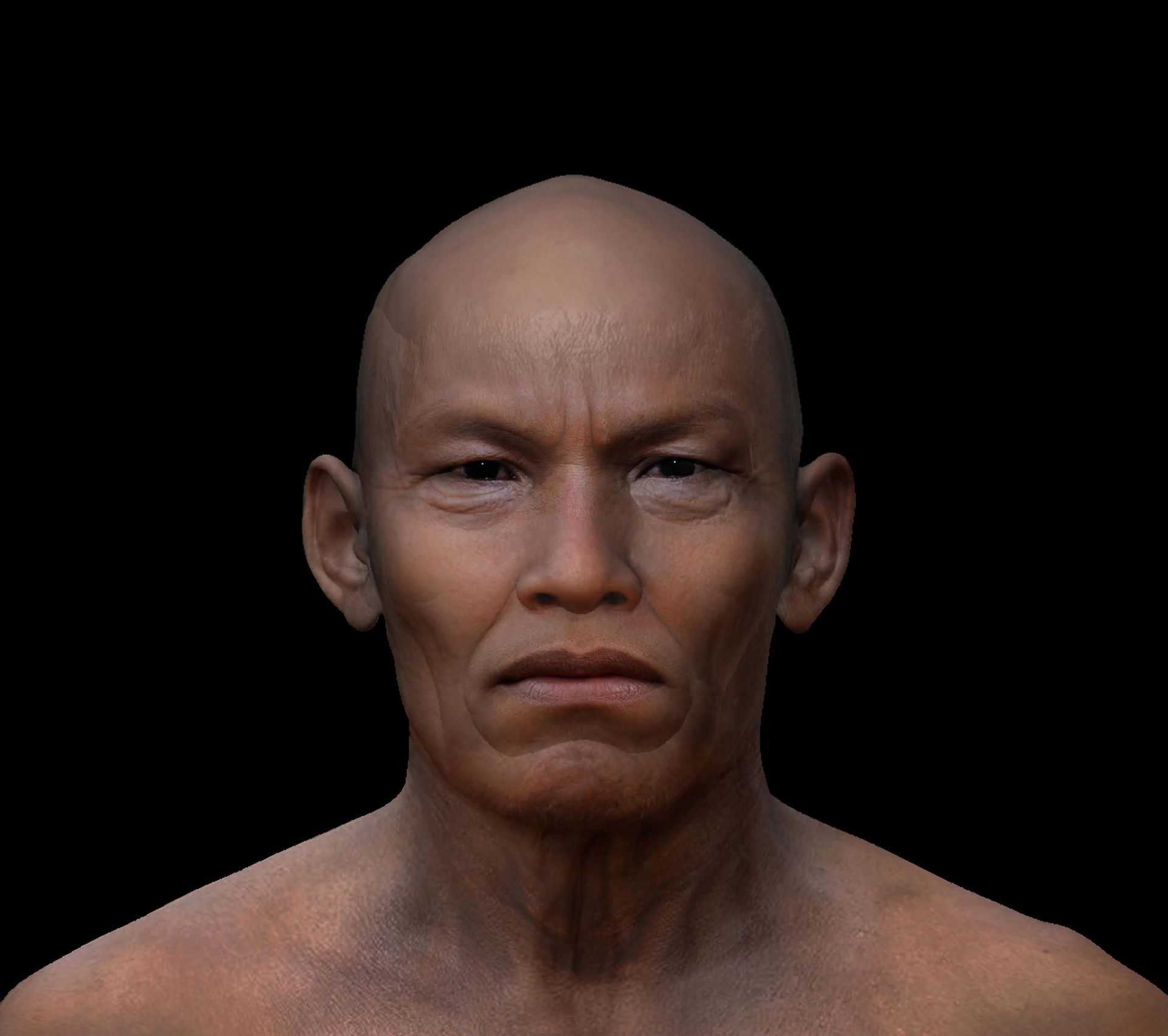 Dr Chris Rynn, University of Dundee
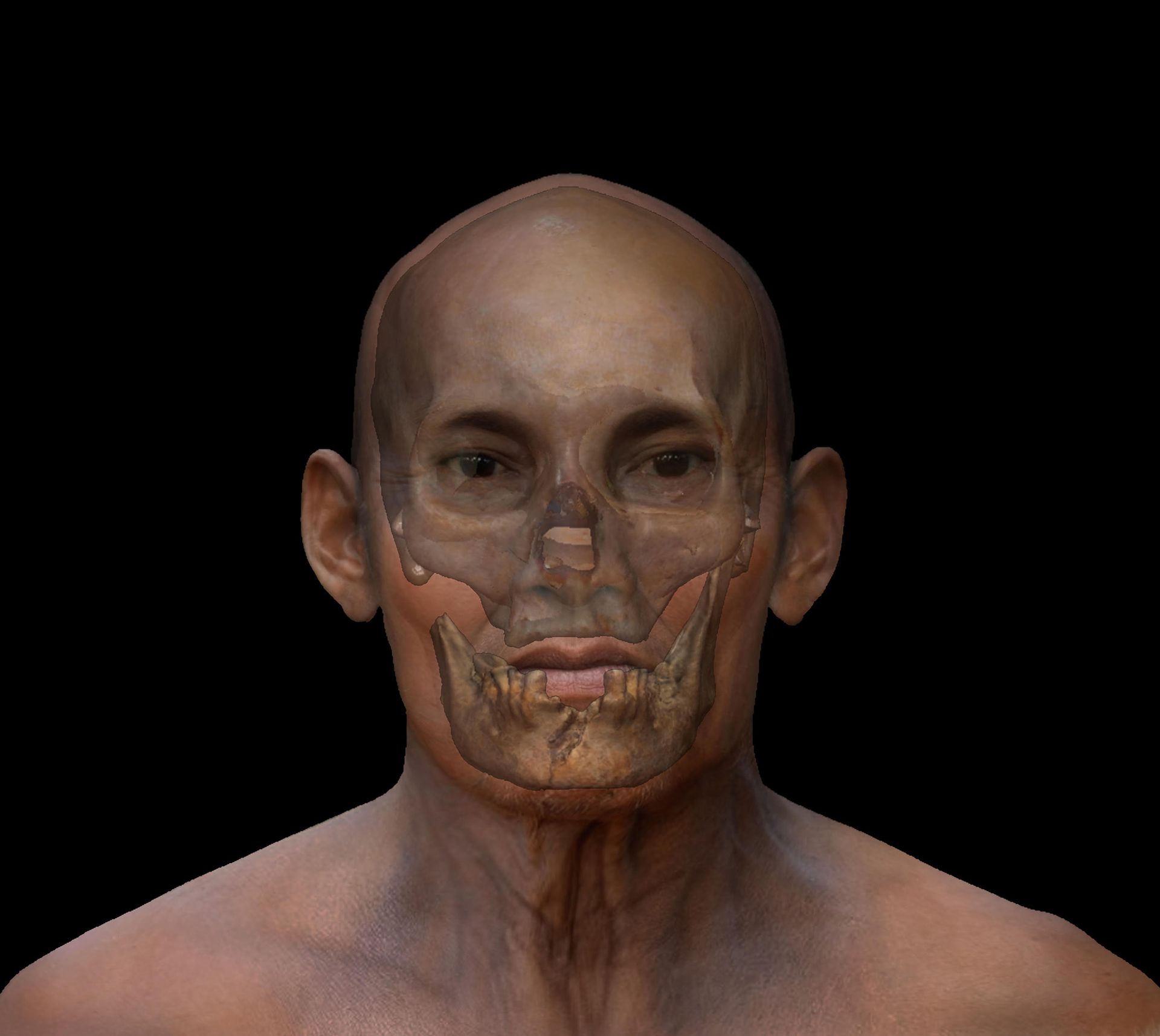 Dr Chris Rynn, University of Dundee
"The hairstyle is very specific," Rynn said. "If it's wrong, it looks like a different tribe."
In addition, some of Rynn's early reconstructions made the eyes too protrusive, as they would be in a skull of East Asian origin, so he followed local advice to make them deeper set. The result is a face that looks distinctly Indigenous American. "It explains a lot to me about the broader nature of skull and face shape differences between Native Americans and East Asians," Rynn said.
Although this reconstruction is digital, it shows the muscles and tissues of the man who lived as a hunter-gatherer more than 3,000 years ago. (Image credit: Dr Chris Rynn, University of Dundee)Faces from the past
Facial reconstructions have been carried out from the remains of hundreds of ancient humans, because archaeologists think these faces provide an important connection to people who might otherwise exist only as old bones.
Rynn has also worked on the reconstruction of a Neanderthal face from about 50,000 years ago. He uses techniques developed at the University of Manchester in the 1970s that are now known as the "Manchester Method," although they are actually a combination of techniques from all around the world, he said.
For the Punin-2 skull reconstruction, Rynn combined digital techniques and partial physical reconstructions with wax to create the face, using libraries of data to determine the right thickness of tissues in particular places.
The digital face has been presented to a select group of people from the Chimborazo region who are likely to be the man's descendants. "It's a portrait of their actual ancestor," Rynn said. "They seem to like it!"
'> 'It's a portrait of their actual ancestor': Facial reconstruction of Indigenous man who lived in Ecuador 3,000 years ago shared with his descendants The tool analyzes hundreds of speech and language patterns to estimate the user's chronological age from the way they talk. In a study involving nearly 3,000 Spanish-speaking adults, those whose estimated age was higher than their actual age were more likely to have cognitive problems, dementia and signs of accelerated biological aging, researchers reported Wednesday (Sept. 30) in the journal Science Advances. They were also more likely to have less favorable social and economic circumstances than other study participants.
This voice-analyzing tool is similar to other "aging clocks," which use various biological markers to predict people's risk of age-related diseases.
"Existing aging clocks are very powerful, but many of them rely on brain scans or blood tests that are expensive, invasive or difficult to repeat regularly," said study co-author Adolfo García, director of the Cognitive Neuroscience Center at the University of San Andrés in Argentina. "All of these limitations can be overcome with speech," he argued.
However, the approach still needs to be tested over time and in other languages before it can be used to assess individual patients' risk of dementia, an expert told Live Science.
How the speech clock works
Researchers used data from the ReD-Lat consortium, a large dementia research project in Latin America. The analysis included over 2,900 Spanish-speaking adults from Argentina, Chile, Colombia, Mexico and Peru; their ages ranged from 18 to 88. Of them, about 1,500 were cognitively healthy; the others had mild cognitive impairment (usually marked by mild memory problems and trouble thinking), Alzheimer's disease or frontotemporal dementia.
Each person completed seven tasks, such as describing an animated video; naming as many words, vegetables or animals as possible in 60 seconds; and retelling a short story immediately after hearing it and then again 20 to 30 minutes later. The scientists took recordings, transcribed them, and then identified more than 700 distinct features of the recordings, including pauses, speaking speed, pitch, vocabulary and emotional expression.
They trained a machine-learning model using those features and the participants' chronological ages, teaching it to estimate age from the way a person spoke. The model generated a predicted age for each participant, and researchers compared it with each participant's actual age to calculate what they called a "speech-age gap."
Some people's speech appeared older than expected for their age, the AI tool determined. Cognitively healthy people had the smallest gaps between their true age and the age the AI assigned them, while people with mild cognitive impairment or dementia had larger gaps. The largest gaps were seen in people with language-dominant frontotemporal dementia, which primarily affects communication.
The human voice is incredibly sensitive to our overall well-being, which means a person's speech could sound 'older' simply because they are severely depressed, exhausted, or navigating serious life stress.
Manisha Parulekar, co-director of the Center for Memory Loss and Brain Health at Hackensack University Medical Center in New Jersey
People with older-sounding speech also performed worse on various tests of memory, language and attention, and they had more difficulty with everyday function. Blood tests showed a similar pattern: Larger gaps were associated with greater age acceleration on three epigenetic clocks, which estimate a person's biological age by looking at chemical tags on top of their DNA. These epigenetic markers affect which genes can be switched on and to what degree.
Among people with Alzheimer's disease, larger gaps were also linked to higher levels of p-tau217, a protein associated with the disease.
Larger gaps were also correlated with various risk factors for dementia, such as having financial difficulties, food insecurity, limited healthcare, difficult childhoods or less education. The pattern was similar across all five countries, despite their social and cultural differences, García noted.
What the speech clock cannot tell us yet
The approach is "a huge leap toward making brain health assessments accessible to everyone," said Dr. Manisha Parulekar, co-director of the Center for Memory Loss and Brain Health at Hackensack University Medical Center in New Jersey, who was not involved in the study.
But the speech clock is not a crystal ball. "The human voice is incredibly sensitive to our overall well-being, which means a person's speech could sound 'older' simply because they are severely depressed, exhausted, or navigating serious life stress," Parulekar told Live Science in an email. "As a clinician, I wouldn't use this tool to definitively diagnose someone with dementia in isolation."
Instead, the speech measure could serve as an additional tool that prompts doctors to take a closer look at a patient's cognitive health, she suggested.
In the study, many participants were assessed at a single point in time rather than monitored over a longer period. The researchers therefore could not determine whether an older-sounding voice can predict whether a patient will soon experience cognitive decline, or whether certain voice changes occur as dementia progresses. Plus, the model was trained and tested only in Spanish-speaking participants from five Latin American countries.
"We cannot just take the Spanish model and plug English into it," Parulekar said. The language-specific features would need to be adapted and tested in other populations, she explained.
The researchers now plan to test the approach with other languages and follow people over time to see whether changes in speech can signal future cognitive decline.
"I truly believe that there is a very, very strong signal in speech to anticipate dementia and conversion in the future," García said, "but we need many more diverse studies."
This article is for informational purposes only and is not meant to offer medical advice.
'> Your voice may reveal how fast you're aging, new AI 'speech clock' suggests